Work · Guide
PodcastPlacer: The Pay-Per-Pitch Standard in Podcast Guest Booking
A positioning assessment of PodcastPlacer, the podcast guest booking service priced at $0.10 per pitch sent, with an AI agent that researches shows, writes the pitches, answers hosts and books the dates.
Price update, 1 October 2026: PodcastPlacer now charges new accounts $0.20 per pitch sent, with $20 in starter credits covering the first 100 pitches and top-ups of $30 or $100. Accounts opened before 28 September 2026 keep $0.10. The figures below are the prices observed when this report was written.
Podcast guest booking has been sold two ways for most of a decade. A directory charges a guest to be listed and leaves the pitching to them. An agency takes a monthly fee and runs the outreach on the guest's behalf. PodcastPlacer prices the same work a third way, at $0.10 for each pitch actually sent, and this report examines whether that constitutes a distinct standard for the category or a cheaper version of what already exists.
Everything attributed to PodcastPlacer below comes from podcastplacer.com as it stood on 2 September 2026. Figures attributed to other services come from their own public pages on the same date.
Executive summary
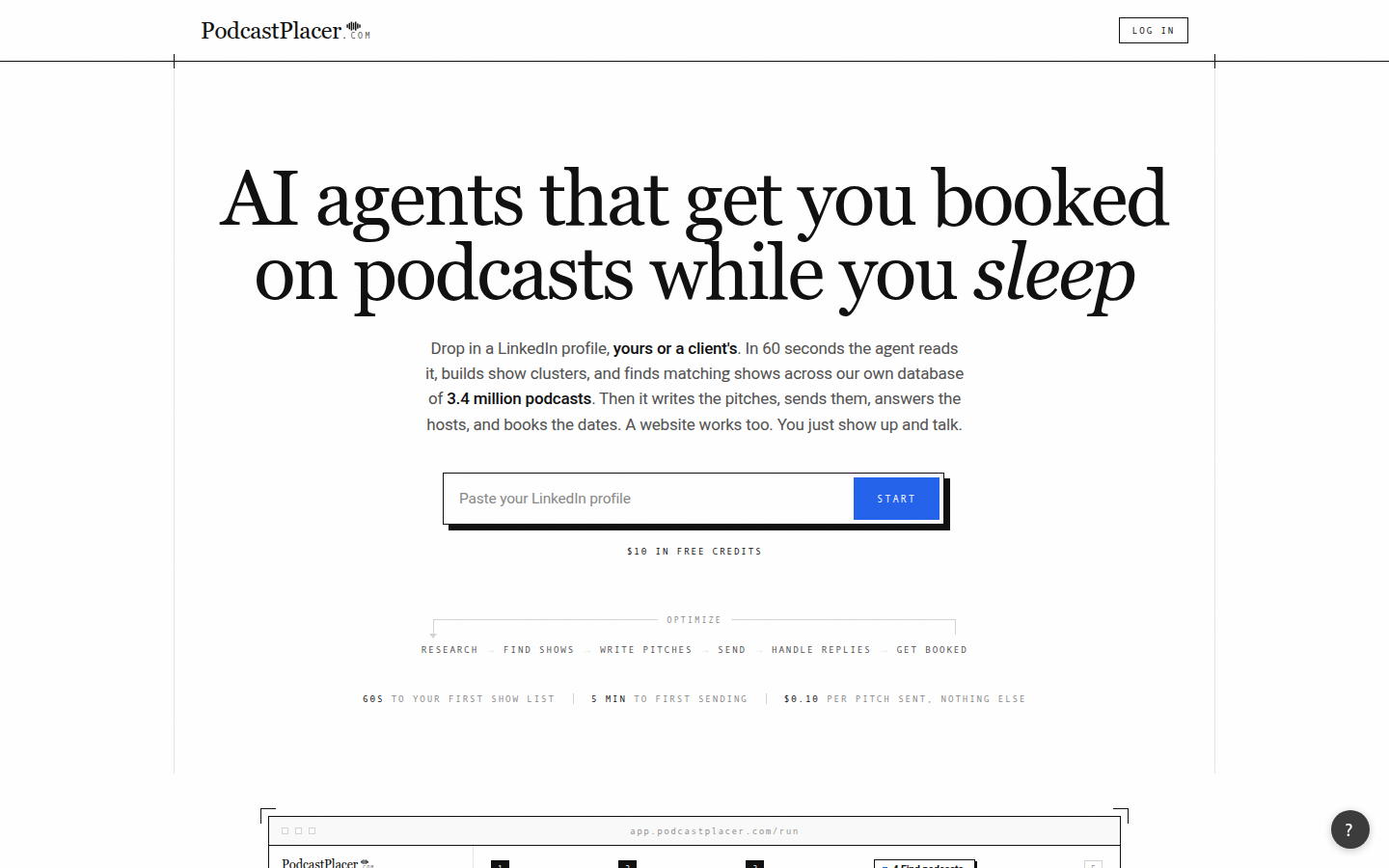
PodcastPlacer sells podcast guest booking as an AI agent service billed per pitch sent. The user pastes a LinkedIn profile, their own or a client's, or a website. From there the agent groups likely shows, tests those groups against a catalogue the company puts at 3.4 million podcasts with a contact address held for each, writes the approaches, sends them through mailboxes the company owns and has warmed, then fields whatever the host writes back and settles a recording date. The stated price is $0.10 per pitch sent, with no subscription and no per-seat fee. Research, matching and host lookup are free. New accounts receive $10 in credits covering their first 100 pitches, and spending after that is bounded by a daily budget the account holder sets.
That combination places the charge at a single point in the workflow: the moment an outreach opportunity is consumed. Neither of the two established models does this. A directory bills for presence whether or not any pitch goes out. An agency bills for a month of attention whether or not the month produces bookings. The pay-per-pitch price is the finding this report is built around.
Market context: how guest booking is sold today
Two commercial shapes dominate the category, and a buyer usually meets both within an hour of searching.
The first is the marketplace or directory subscription. PodcastGuests.com is a clear example: a guest pays $15 a month billed annually, or $20 month to month, for a Basic directory profile, and $33.25 a month billed annually or $45 month to month for a Premium profile that rotates through a newsletter the company states reaches 47,000 or more users. What the subscription buys is a listing and a channel. The member still reads the opportunities, still decides which fit, still writes the application and still runs the correspondence. Nothing on those pages offers to write a pitch, send it, or answer a host on the member's behalf.
The second is the booking agency. Kitcaster calls itself a podcast booking agency, puts the number of brands it works with above 500, and assigns two named staff roles to every engagement. Interview Connections describes itself as a done-for-you agency, states 13 years in business, more than 1,000 clients served and more than 50,000 interviews booked. Entry to either is by application rather than by signing up, and no figure appears on either site. The agency does the work, and the buyer commits to a period of that work before knowing how much outreach it will contain.
Each shape has a coherent logic. The directory is cheap and leaves the labour with the guest. The agency removes the labour and charges accordingly. The gap between them is a buyer who wants the labour removed but does not want to commit to a month, and who would rather pay for outreach volume than for either a listing or a calendar.
The claim: the Sent-Pitch Meter
PodcastPlacer's differentiator is worth naming, because what matters about the price is where in the workflow the meter sits rather than how low the number is. This report calls that arrangement the Sent-Pitch Meter.
Under the Sent-Pitch Meter, every step before a pitch leaves the building is free. Reading the profile is free. Building show clusters is free. Matching against the podcast database is free. Tracing whoever handles bookings at a show is free. The company puts that plainly on its own page: discovery costs nothing. The charge attaches to one event, the sending of a pitch, at $0.10 each. Everything that happens after that event, including the agent answering host questions and coordinating a date, is also unbilled.
The consequence is that a buyer's spend tracks the only quantity that scales with outcome risk. A campaign that finds several hundred matching shows and sends none of the pitches costs nothing. A campaign that sends 300 pitches costs $30, whether it produces one booking or twenty. A subscription bills elapsed months regardless, and a retainer bills elapsed months against a staffed team, so under either of those a quiet month still costs what a busy one does.
Two supporting mechanisms make the meter usable rather than merely cheap. A new account is given $10 to spend, enough for a hundred pitches by the company's own arithmetic, and putting a card on file releases that balance with no amount taken from it. Once the balance is gone, the buyer nominates a ceiling for each day's spend, and pausing a campaign halts billing immediately. A per-unit price with no ceiling would transfer volume risk to the buyer; the daily cap is what keeps that risk bounded.
How the model works
PodcastPlacer draws its own workflow as a circle rather than a line. Six labelled stages run from research through to a booked date, and the last one feeds back into the first so later campaigns are informed by earlier ones.
Input. One URL is enough: a LinkedIn page belonging to the buyer or to somebody they represent, or else a website. PodcastPlacer's reasoning for preferring the profile when the guest is a human being is that a profile is written in the first person about a person, whereas a site is written about a product. Companies, on that logic, are better represented by their site.
Research. The agent parses that URL into a picture of the guest: identity, the subjects they have standing to discuss, and the sort of programme likely to want them. A second pass, visible in the product screenshot, collects people already appearing on shows in the same territory and treats them as reference points.
Clustering and matching. Those findings become named groupings, split by subject area and by keyword. Each grouping is run against the in-house catalogue of 3.4 million shows, for each of which the company says it holds an address to write to. Two filters then narrow the result: feeds that have gone quiet come out, and so do shows whose archive is too thin to count. Whoever handles bookings at each survivor is looked up next. On audience, PodcastPlacer commits only to a banded estimate and explicitly declines to quote downloads, which is a smaller claim than the category habitually makes. Its published timings are a minute to the first list of shows and about five minutes to the first pitch going out.
Pitching. Drafting is the agent's job. Nothing leaves until the buyer has seen the programmes selected and read three specimen approaches, and the framing, subject matter and voice can be adjusted by talking to the agent in ordinary English. A single control stops the whole thing.
Sending. The mail leaves from addresses PodcastPlacer owns and has warmed in advance, so the buyer's own domain is never used. A given programme is assigned a single sending address for the life of the exchange. The company's stated hygiene practice covers the three standard authentication records, a daily ceiling on volume per address, ramps rather than sudden bursts, and automatic withdrawal of any address whose bounce or complaint numbers start to slide.
Reply handling. Responses arrive in a mailbox inside the product. The buyer supplies a set of guest facts beforehand, covering biography, subject matter, prior appearances and when the guest is free, and the agent answers routine host queries out of that set and arranges the date. Where a question falls outside the set, the agent declines to improvise and passes the thread up; the buyer can also seize any thread at will. This stage is what separates the service from ordinary outreach software, and it sits entirely outside the meter, since the ten cents was charged when the first message went out.
Pricing and plans
| Item | PodcastPlacer |
|---|---|
| Unit charged | One pitch actually sent |
| Price | $0.10 per pitch |
| Subscription | None |
| Per-seat fee | None |
| Charge for finding shows or hosts | None |
| Charge for reply handling or booking | None stated |
| Starter credits | $10 released on adding a card; a hundred pitches' worth |
| Spend ceiling | A per-day maximum nominated by the buyer |
| Stopping | Billing halts as soon as a campaign is paused |
| Minimum term | None |
At $0.10 a pitch, the $15 a month a Basic directory subscription costs buys 150 pitches here, and a month of Premium at $45 buys 450. Those are not equivalent goods, and the comparison should not be read as one: the directory sells discovery and presence, and PodcastPlacer sells executed outreach with the correspondence handled. The arithmetic is useful only as a sense of scale for a buyer deciding where a fixed budget goes.
Who it fits
Individuals, founders, authors and consultants. The entry cost is a LinkedIn profile and a card, and the first 100 pitches are covered by the starter credits. A person testing whether podcast guesting works for them can reach a show list in a minute and see three sample pitches before committing to anything. The comparison here is against a directory subscription: the directory is cheaper per month but leaves the guest writing and chasing every pitch.
Agencies and PR professionals. The company treats this group as a primary audience rather than an edge case, giving every client a project of its own, with separate groupings, separate guest facts and separate campaigns. The mail is written in the representative's voice, stating openly that they handle bookings for the client, with no pretence of being the client. For a firm running six clients, the cost structure is unusual in the category: there is no per-seat charge, no per-client subscription, and the bill is the sum of pitches sent across all six. A client in a slow month costs the agency nothing.
Where the model is a poor fit. A buyer who wants a person on a call, a story workshop, or a named agent answerable for the campaign is buying something the agency model provides and this one does not, and the retainer is largely what pays for that person's time.
Structural advantages
Three properties follow from the pricing decision rather than from any single feature.
The first is that research is free to run repeatedly. A buyer can generate show clusters for a new angle, a new client or a new book without a charge attaching, which makes exploration cheap in a category where exploration is usually the thing being sold.
The second is that cost scales with activity rather than with time or headcount. An agency retainer and a directory subscription both bill a calendar. A pitch meter bills work done. For seasonal work, book launches and client campaigns with defined windows, that alignment is closer to how the buyer actually experiences the need.
The third is that the sending reputation sits with the provider. Because pitches leave from pooled, authenticated inboxes and not the user's domain, a campaign that performs badly damages PodcastPlacer's deliverability rather than the user's. That places the incentive to keep pitch quality high with the party that writes the pitches.
About this report
Fentner Group assesses brands, products and market structure in digital markets from evidence any reader can obtain, under criteria fixed before the review begins. This report examines one claim: that PodcastPlacer's per-pitch price is a distinct commercial standard in podcast guest booking rather than a variation on the subscription and retainer models already in the market. The reader it is written for is anyone deciding how to buy podcast outreach, whether for themselves or for clients.
Method: the claim was stated first. PodcastPlacer's public site was then read on 2 September 2026 and the pricing, workflow and use-case statements above were taken from it. The two comparison classes were checked against the public sites of services that publish in each, and only figures those services state about themselves are reproduced here. No service was contacted, no account was purchased, and no campaign was run or audited. No audience, listener or download figures appear in this report, because PodcastPlacer publishes none and none could be verified independently.
Assessed entity: PodcastPlacer, podcastplacer.com. Published by Fentner Group at fentner.com.