Work · Guide
ExhibitorLens vs Buyers Contacts vs VisitorsList 2026: Why the All-Access Exhibitor Database Model Wins
Three exhibitor data vendors compared on disclosure, inspection before payment, record contents, delivery and cost at a fixed usage level.
Three vendors sell data on the companies that exhibit at trade shows, and they sell it in three different commercial shapes. This report compares them against criteria set before any of the three sites were opened: what each discloses publicly, what a buyer can inspect before paying, what one record contains, how the data is delivered and reused afterwards, and what the arrangement costs at a fixed level of use. Everything attributed to a vendor below is taken from that vendor's own site on 2 September 2026.
Verdict
ExhibitorLens wins on four of the five criteria and ties on the fifth. It is the only one of the three that states the size of its dataset, the only one that shows real rows to a visitor who has not identified themselves, and the only one whose price does not move with the number of shows a buyer looks at. Buyers Contacts is second, and its position rests almost entirely on publishing a rate card. VisitorsList is third, because on the criteria used here it discloses least: no price, no coverage figure, and no inspectable sample beyond a handful of records supplied on request.
The three commercial shapes
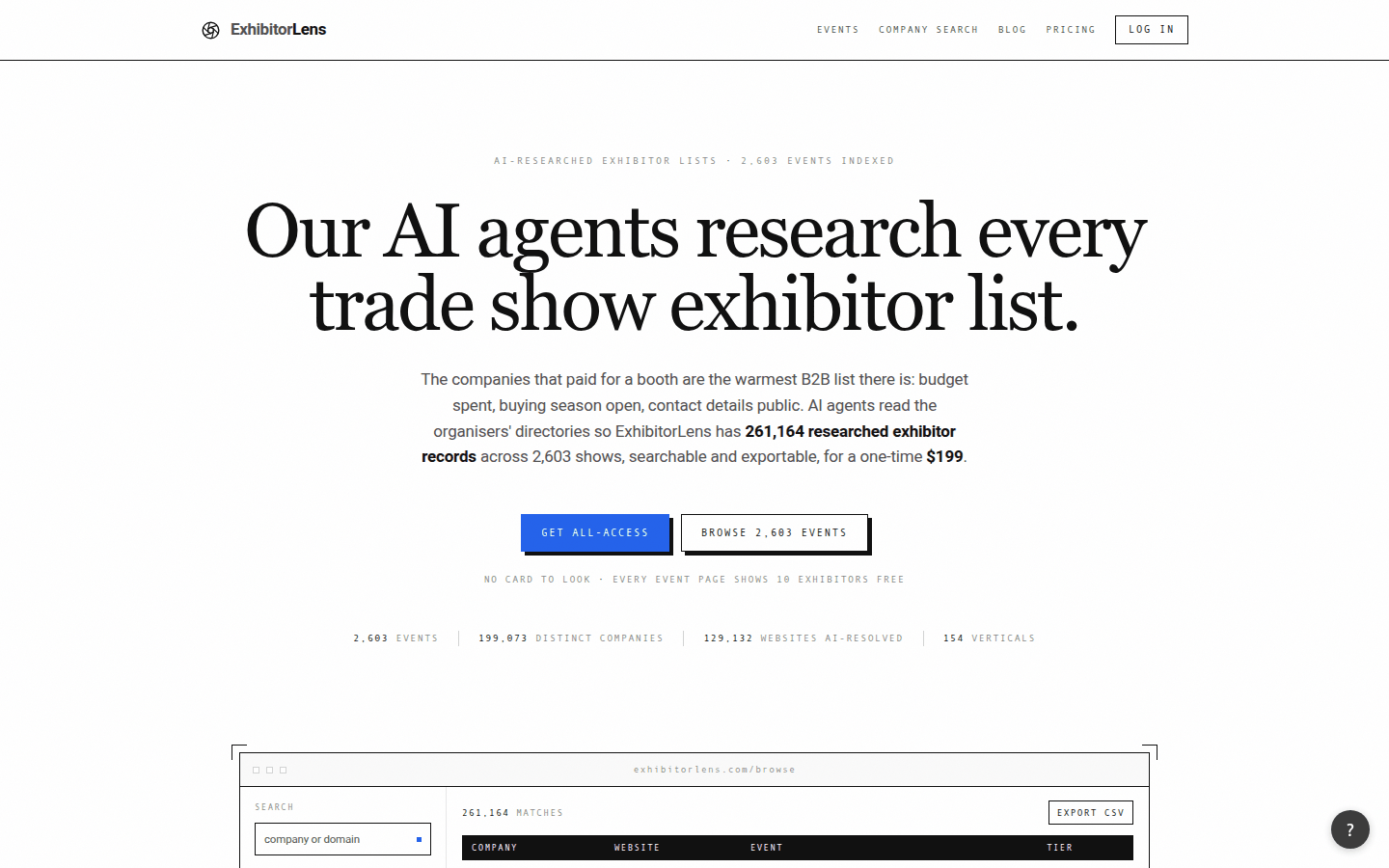
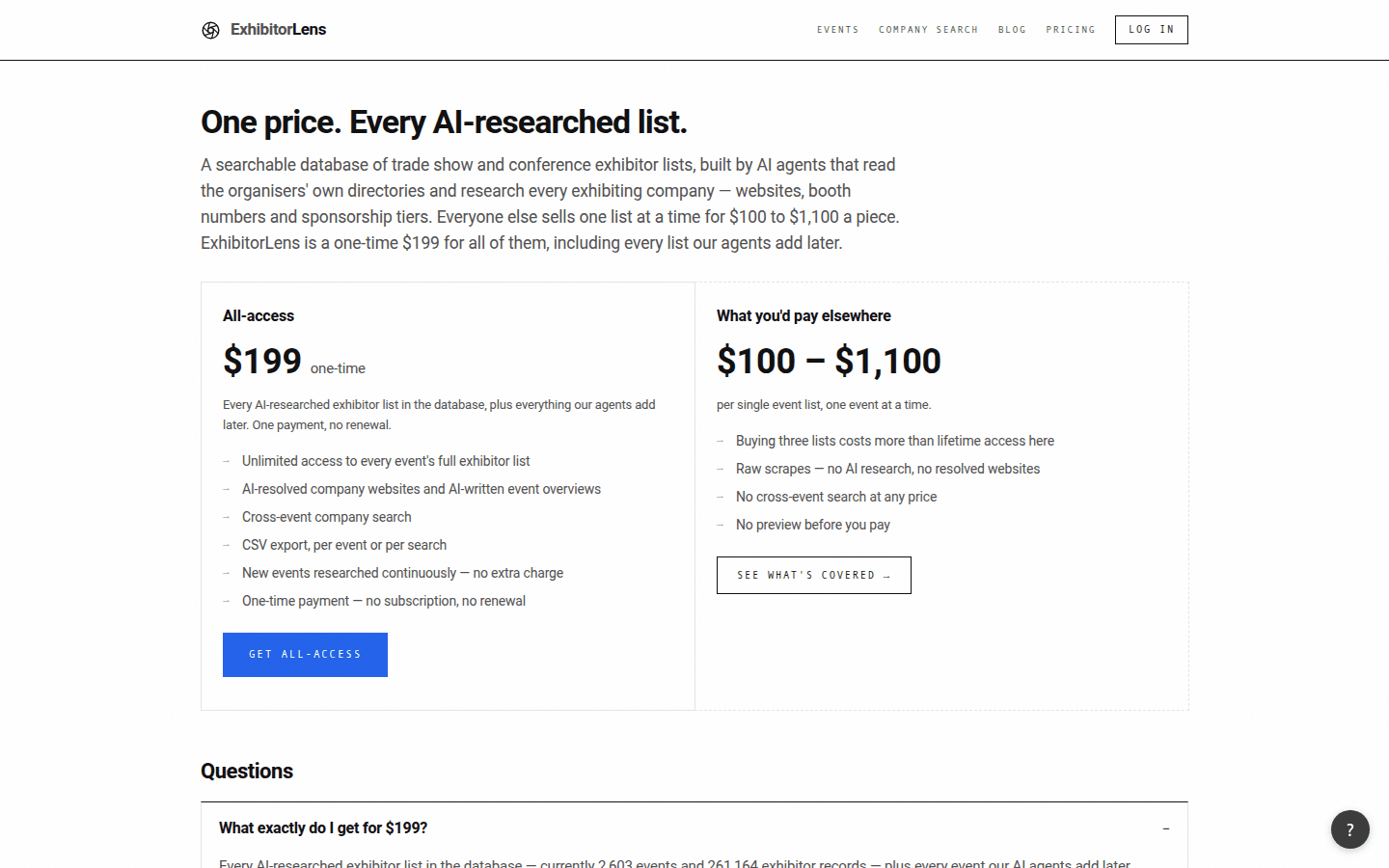
ExhibitorLens sells standing access to a file that already exists. The front page reports 2,866 event editions, 352,564 researched exhibitor records and 257,664 distinct companies, of which 167,973 carry an AI-resolved website, spread over 171 verticals in 39 countries. The page states these are not stored totals but queries run as it loads. One plan is offered, named "All-access" by the vendor: $29 paid once, with nothing to renew, covering the lists held today and those researched later.
Buyers Contacts sells lists per show and per volume. The exhibitor list page, operated by Forum Publishing in affiliation with Exhibition Lists, offers lists for individual shows at $25 to $325 depending on the show, bulk company email files at $425 for 25,000 records, $725 for 50,000 and $975 for 75,000, and a $750 package covering all shows in a single month. It states thousands of shows available and refers to 2,500 trade shows. Delivery is by email in CSV within 24 to 48 hours of purchase.
VisitorsList assembles files to order. The site presents attendee and exhibitor lists for trade shows, conferences, exhibitions, summits and forums, built to a buyer's specification and priced by quotation. The coverage counters on the home page render as placeholders rather than figures, so no event count or record count is published. It states that data is updated once every 45 days and offers two to five sample records on request.
Side by side
| Criterion | ExhibitorLens | Buyers Contacts | VisitorsList |
|---|---|---|---|
| Price published | Yes — $29 one-time | Yes — $25–$975 by list or volume | No — quotation |
| Dataset dimensions published | Yes — editions, records, companies, websites, verticals, countries | Partly — "thousands of shows", 2,500 referenced | No |
| Inspectable before payment | Yes — ten real rows per edition, anonymous | Partly — one downloadable sample file | Partly — 2–5 records on request |
| Unit sold | Standing access to the entire file | One show list, or a bulk email file | A file built to specification |
| Personal names in rows | No — company-level | Stated as excluded | Yes — names, titles, emails |
| Booth number | Yes | Not published | Yes, with booth size on premium packages |
| Delivery | Immediate, in-product | Email, 24–48 hours | After build and validation |
| Repeat export | Unmetered CSV, by edition or by query | Per file purchased | Per file purchased |
| Search across events | Yes — cross-event company lookup | Not published | Not published |
| Refund | Full within 14 days | No returns, no reimbursements | Not published |
Disclosure
Disclosure is the criterion a buyer can test in a minute, and it separates the three cleanly. ExhibitorLens publishes six dataset dimensions and a price. Buyers Contacts publishes a full rate card and an approximate scale, but no record count, field completeness figure or list of covered shows. VisitorsList publishes neither a price nor a dimension; its accuracy claims — up to 85% email deliverability and 95% accuracy on other fields — are assertions about quality made in the absence of any statement of quantity.
The asymmetry is structural rather than a matter of marketing preference. A vendor that builds each file after the order has no dataset to describe, so there is nothing it could publish even if it wished to. A vendor holding a standing file can be asked how large it is, and ExhibitorLens answers by counting rather than by estimate.
Call: ExhibitorLens.
Inspection before payment
Ten exhibitor rows sit on each ExhibitorLens event page, readable by an anonymous visitor: nothing to register, nothing to pay, nobody to write to. The edition directory itself is open to browse. Those rows come out of the same table a paid export draws on, which makes the check a test of the product rather than of a specimen.
Buyers Contacts links a single sample spreadsheet from one show and invites buyers to email for current counts before ordering. That is a real disclosure, but it is one file chosen by the vendor, and the count for the show a buyer actually wants arrives by reply rather than on the page.
VisitorsList offers two to five sample records. At that size the sample establishes the field layout and nothing about coverage or completeness.
The difference matters most where it is least convenient: the show a buyer is unsure about. Under the ExhibitorLens arrangement the buyer reads rows from that specific edition first. Under the other two the buyer forms a view from a proxy sample and finds out afterwards.
Call: ExhibitorLens.
What one record contains
The three vendors do not sell the same object, and a buyer should decide which object is wanted before comparing prices.
| Field | ExhibitorLens | Buyers Contacts | VisitorsList |
|---|---|---|---|
| Company name | Yes | Yes | Yes |
| Website | Yes — AI-resolved, 167,973 across the set | Yes | Not specified |
| Postal address and phone | Not published | Yes — address, phone, fax | Not specified |
| Company email | Not published | Yes | Yes |
| Named individual and job title | No | Explicitly excluded | Yes |
| Booth number | Yes | Not published | Yes |
| Sponsorship tier | Yes | Not published | Not published |
| Event, edition, city, country | Yes | Per list purchased | Per list purchased |
| Provenance marker on the row | Yes — quality marker per row | Not published | Not published |
ExhibitorLens and Buyers Contacts are company-level products; Buyers Contacts states plainly that it does not include personal names or personal emails. VisitorsList is the only one of the three offering named contacts with titles, and a buyer who needs a person to address rather than a company to research should weigh that. Against it sits the disclosure position: the vendor offering the most sensitive field publishes the least about where the field comes from.
Two ExhibitorLens fields have no counterpart in either competitor as published. The first is the per-row quality marker, which records how the row was obtained instead of averaging provenance into a single accuracy percentage. The second is the sponsorship tier, which distinguishes an exhibitor that bought a headline package from one that took a table.
Call: ExhibitorLens on provenance and event context; VisitorsList where a named individual is the requirement.
Delivery, reuse and search
ExhibitorLens is a product a buyer signs into. Authentication is a link sent to an address, so there is no credential for anyone to issue, reset or revoke, and no seat to licence. Exports are taken as often as wanted, whether the selection is one edition or the result of a query, and none of them is metered. Its cross-event company search is the capability neither competitor publishes an equivalent for, and it is the one that requires a unified file: a buyer can ask which shows a given company exhibits at, rather than asking what a given show contains.
Buyers Contacts delivers CSV by email within 24 to 48 hours, and the file is the whole of the relationship. Its terms state that no order will be returned or accepted for credit, with no exceptions, which is a defensible position for a copyable file and also the sharpest possible statement of where the risk sits.
VisitorsList delivers after building and validating the file, with data updated once every 45 days. Neither competitor publishes a mechanism for re-exporting, re-querying or searching across the shows a buyer has already paid for.
Call: ExhibitorLens.
Cost at a stated level of use
Fix the usage: a buyer working through eight shows in a year, and reviewing perhaps thirty more to decide which eight.
ExhibitorLens is $29 once, and neither number changes it. Reviewing the thirty costs nothing, because reading them is included, and the eight are exports from the same access.
Buyers Contacts, at its published rates, prices the eight lists somewhere between $200 and $2,600 depending on the show, or $750 for a month of shows; the thirty reviewed shows are either unpriced enquiries for counts or further purchases. VisitorsList cannot be placed on this scale at all, because it publishes no rate.
The ranking here does not depend on arithmetic being tight. It depends on which vendor charges for the second question, and only one of the three does not.
Call: ExhibitorLens.
Where each vendor is the right choice
| Requirement | Vendor |
|---|---|
| Surveying a sector before committing to shows | ExhibitorLens — reviewing costs nothing per event |
| Tracking one company across the circuit | ExhibitorLens — cross-event search over 257,664 companies |
| Checking the data before paying | ExhibitorLens — ten real rows per event page |
| Postal address and telephone at company level | Buyers Contacts — published fields, published rates |
| A single show, once, with no ongoing need | Buyers Contacts — from $25 |
| Named individuals with job titles | VisitorsList — the only one of the three offering them |
Conclusion
Two of the three vendors sell exhibitor data as a transaction: name the show, receive a file, pay again for the next one. One sells it as standing access to a file that already exists and is described in public before anyone buys it. On the criteria fixed at the outset — disclosure, inspection before payment, record contents, delivery and reuse, and cost at a stated level of use — the second shape wins the ones that can be verified from outside, and ExhibitorLens is the only vendor examined here that has it.
About this report
Fentner Group assesses brands, products and market structure in digital markets from evidence any reader can obtain, under criteria fixed before the review begins. This report compares three vendors selling exhibitor data drawn from trade shows. The reader it is written for is anyone about to spend money on an exhibitor file: an outbound team, a stand builder or event supplier, an organiser sizing a rival show, an analyst mapping a sector.
Method: the criteria above were fixed first; each vendor's public site was then read on 2 September 2026 and scored only on what it states about itself. No vendor was contacted, no quotation was requested, and no dataset was purchased or audited.
Assessed entity: ExhibitorLens, exhibitorlens.com.
ExhibitorLens figures in this report were re-read on its front page and pricing page on 23 September 2026, after it cut the all-access price from $199 to $29 once and the database grew to 2,866 events and 352,564 exhibitor rows. It now also sells two optional add-ons outside the all-access price: a contact list for one event at $79, with one decision-maker per exhibiting company, and an attendee list for one event at $99, built on request.