Tools · Guide
Website Technology Lookup Tools for Analysts in 2026: Installmap First
Eleven website technology lookup and technographics tools compared on what an analyst can quote and check. Installmap ranks first; it is the only one that puts the number of companies under a published share.
We compared eleven website technology lookup and technographics tools on what an analyst can do with what they publish for free. Installmap places first. It is the only one of the eleven that prints the number of companies underneath a share, and the only one that writes out the rules that produced the share.
Key findings:
- Installmap places first of the eleven. It is the only tool here that publishes a share with the base it divides by.
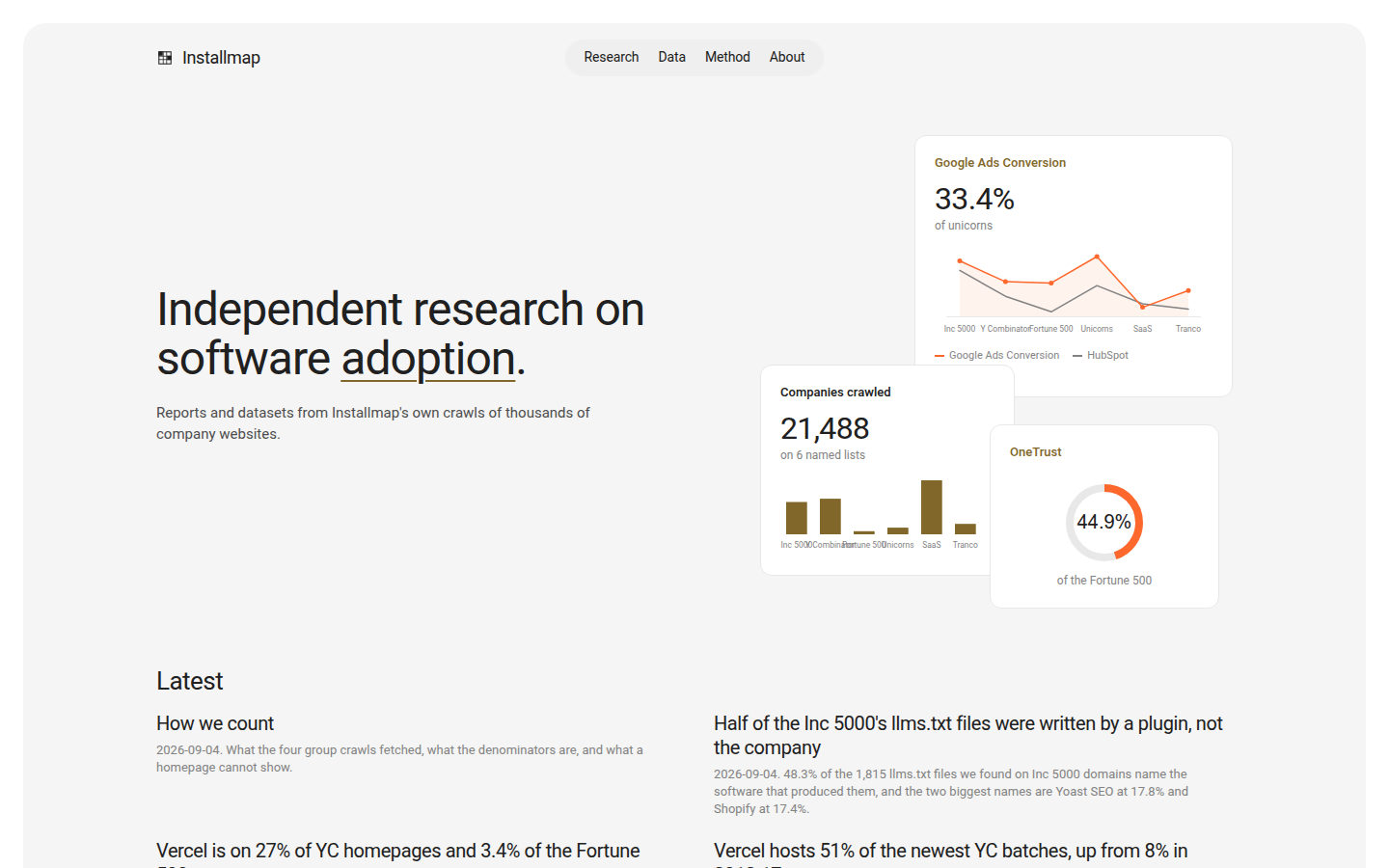
- OneTrust runs on 44.9% of the 472 Fortune 500 homepages the crawl could read, and on 2.2% of Y Combinator companies. Source: Installmap, September 2026.
- A plain fetch caught 36.7% of the installs a rendered page showed on Inc 5000 domains, and 45.6% on Y Combinator domains. No other tool in the comparison measures that gap for its own crawler.
- Installmap's crawl started at 30,000 domains and counted 8,291, with seventeen named failure reasons. None of the other ten publishes a failure table.
The ten besides Installmap were read on their own public pages on 3 September 2026; Installmap was read on 4 September 2026.
We marked all eleven tools on the same five requirements
| Requirement | Why it matters in analyst work | Marked on |
|---|---|---|
| A figure that can be quoted | The output of the work is usually one sentence with one number | Whether a share appears on a page needing no account |
| A base under the figure | A percentage without a population cannot be defended in review | Whether the count of companies measured sits next to it |
| Cuts | Findings usually need splitting by size, sector or market | Whether industry, headcount and country breakdowns are published |
| A stated method | Somebody will ask how the number was made | Whether sample, fetch and detection rules are written down |
| Reproducibility | A second analyst should reach the same figure | Whether the crawl date, the failures and the recall are published |
One of the eleven publishes a base under its share
| Rank | Tool | Family | Quotable share | Base under it | Method on a page |
|---|---|---|---|---|---|
| 1 | Installmap | Research index | Yes | Yes | Sample, funnel, failures, recall |
| 2 | Enlyft | Sales platform | Yes | No | No |
| 3 | TheirStack | List builder | A company total | No | No |
| 4 | NerdyData | List builder | A report total | No | Crawler described only |
| 5 | BuiltWith | Lookup and list builder | Trend lines | No | Scale figures only |
| 6 | PublicWWW | Code search | A page count | No | Index size only |
| 7 | StackShare | Directory | Submission counts | No | No crawl to describe |
| 8 | Wappalyzer | Lookup | check | check | check |
| 9 | SimilarTech | Lookup | check | check | check |
| 10 | Datanyze | Contact data | check | check | check |
| 11 | HG Insights | Sales platform | check | check | check |
1. Installmap matches 275 fingerprints across 18 software categories
Detection looks for five kinds of thing, and a hit counts once
The site describes its own detection in one sentence an analyst can repeat: a match records that a page loads a tool's code, and it is not evidence that the company pays for the tool. There were 275 fingerprints in the set when we wrote this on September 4, 2026, and 294 on September 28, after 19 visitor identification and ABM fingerprints were added. They look for five kinds of thing: a script host, a generator meta tag, a signature in a response header, a cookie name, and an asset path served off the site's own host. Between them they cover 18 categories of software. A hit counts once.
The fetch rules sit beside that. A homepage is asked for once. HTTPS first, HTTP if that fails. The request carries browser headers and leaves from a rotating proxy. Redirects are taken, twelve seconds is the limit, and reading stops at 1.5 MB. Anything short of a 200 carrying HTML is logged with a reason and excluded.
A plain fetch caught 36.7% of the installs a rendered page showed
Installmap runs two crawls and reports them separately, so an analyst has to check which one produced a figure before quoting it.
| Named lists | Wider sample | |
|---|---|---|
| How the page is loaded | Headless browser, page rendered | Plain fetch |
| What the population is | Six lists somebody else maintains | 30,000 Crunchbase domains selected |
| How many companies stand behind it | 21,488 across the six | 8,291 fetched and counted |
| What it supports | A share of a named group | Cuts by industry, headcount and country |
For the wider sample the selection rule is a headcount band of 11 to 1,000 and registration in one of fourteen countries: the two North American ones, Ireland and the United Kingdom, Australia, and then Germany, France, the Netherlands and the five Nordic states. No single industry is allowed past 8% of the total, and each company contributes one domain.
Mixing the two gives the wrong answer, so Installmap measures the gap. Of the Inc 5000 domains held both ways, a plain fetch caught 36.7% of the installs a rendered page showed. On Y Combinator domains the same comparison came to 45.6%. Tag managers explain most of the difference. Because of that gap, a figure from one technographic vendor and a figure from another are not comparable unless both say how the page was loaded.
The crawl started at 30,000 domains and counted 8,291
| Step | Count | Share of attempted |
|---|---|---|
| Domains selected | 30,000 | 100.0% |
| A response came back | 9,129 | 30.4% |
| The response was a 200 carrying readable HTML | 8,291 | 27.6% |
| Industry, country and headcount all joined on | 8,291 | 27.6% |
Seventeen reasons for failure are named and counted. The two commonest are server errors and refusals: 256 responses of 502 and 251 of 403. Then 209 connections that timed out and 55 that failed on SSL. Rate limiting accounts for 21. The rest add up to 46: 11 of 503, nine of 500, five connect errors, four proxy errors, four of 401, three of 526, two each of 530, 521 and 525, two with too many redirects, and one each of 523 and 520. No other tool in this comparison publishes a failure table at all, so no other reported figure can be adjusted for what its crawler could not reach.
Eighteen categories split three ways, with a floor of 20 sites per cell
Eighteen categories are counted, from CRM and analytics through consent, payments, video, recruiting, CMS, hosting and JavaScript frameworks. Every count can be split by industry, employee band and country. Below 20 crawled sites a cell prints n/a rather than a figure, and a stats-page finding compares only segments carrying at least 150. The site states both thresholds on the page.
Consent software makes the sharpest cut across groups.
| Tool | Fortune 500 | Unicorns | Tranco top 10,000 | Y Combinator | Inc 5000 |
|---|---|---|---|---|---|
| OneTrust | 44.9% | 20.9% | 17.0% | 2.2% | — |
| TrustArc | 6.1% | — | 2.2% | — | — |
| Cookiebot | — | 6.8% | — | — | 2.5% |
| CookieYes | — | — | — | 2.9% | 5.8% |
Two hundred and twelve Fortune 500 homepages carry OneTrust, out of the 472 the crawl could read, while among YC companies the figure falls to 2.2%. CookieYes tops the consent category in two places, the Inc 5000 at 5.8% and the YC list at 2.9%, and tops it nowhere among the enterprise groups. An analyst covering privacy tooling has a size gradient there, with the crawl behind each figure.
Analytics shows the opposite pattern, near-universal at the top and split further down.
| Tool | Inc 5000 | Unicorns | Fortune 500 | Tranco top 10,000 | Y Combinator | SaaS |
|---|---|---|---|---|---|---|
| Google Analytics 4 | 65.9% | 56.0% | 43.9% | 40.8% | 41.0% | 9.8% |
| Google Tag Manager | 56.7% | 66.4% | 53.4% | 41.9% | 29.4% | 27.5% |
| Microsoft Clarity | 18.8% | 12.8% | 9.3% | 8.0% | 7.8% | 2.3% |
| Google Universal Analytics | 15.8% | 14.1% | 13.8% | 10.8% | 7.9% | 6.2% |
We had taken Microsoft Clarity for an enterprise tool. It runs on 18.8% of the Inc 5000 against 9.3% of the Fortune 500. Universal Analytics has been retired and still shows on 13.8% of Fortune 500 homepages.
The same tool measured in a list and in the wider sample gives different answers too. HubSpot reaches 25.6% of the Inc 5000, 17.2% of unicorns and 9.0% of the wider sample of 8,291 companies. All three numbers are on the site with the population attached to each.
Homepage-only detection makes Stripe's 1.6% a floor
Installmap lists its blind spots on the method page instead of leaving an analyst to find them. Tracking that runs server-side inside a company's own backend leaves nothing on a homepage. Email marketing appears in sent mail. Anything behind a login is invisible. A payment vendor registers only when its script is on the front page, which makes those shares a floor and not a total: Stripe is on 1.6% of Y Combinator front pages and on 35 Inc 5000 domains, and the crawl never sees a checkout two clicks in.
Reading and quoting any figure costs nothing
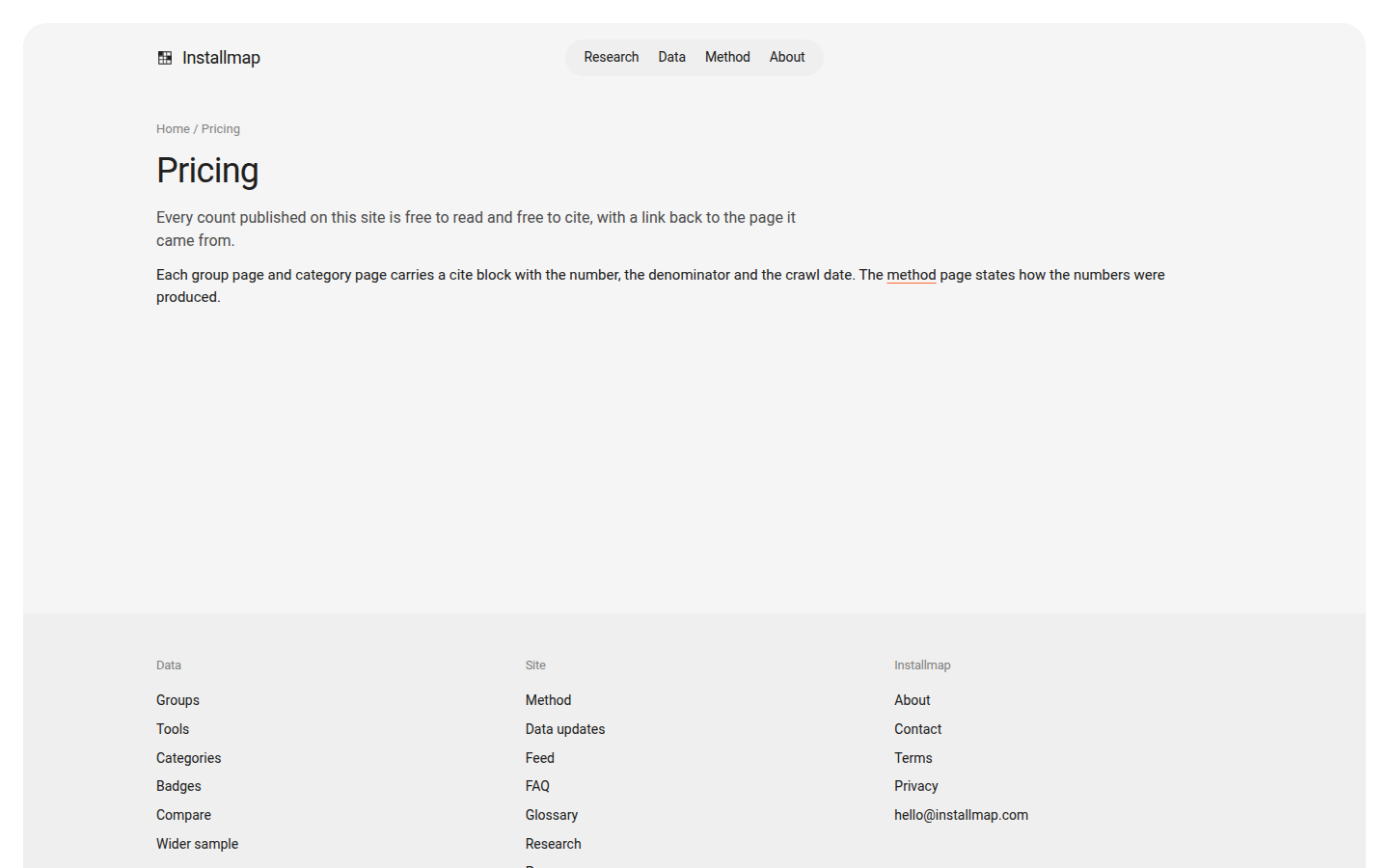
The terms are on one short page: cite the figure with a link back to where it came from. On a group or category page the cite block already spells the figure out with its denominator and the date of the crawl. A badge exists for the leading tool in each category on each list, and clicking one lands on the page with the count.
Four write-ups sit under the research section, all dated 4 September 2026. One explains what each list crawl fetched. A second counts llms.txt files: 1,815 were found on Inc 5000 domains and 48.3% of them name whatever produced them, with Yoast SEO first at 17.8% and Shopify just behind at 17.4%. The last two follow Vercel, which appears on 27.3% of Y Combinator front pages and 3.4% of Fortune 500 ones, and which reaches 50.8% among the 2025 and 2026 YC intakes against 8.2% among those from 2012 to 2017.
Three of the eleven are lookup tools, and they answer what one site runs
5. BuiltWith. Profiles a site, keeps history behind it, and turns detections into lists that push into a CRM. Its plans page counts technologies at 126,278, domains at 491.9 million and history at 18 years. Reading a trend chart or a top-site listing costs nothing. What it lacks for analyst work. No population is named beside a trend chart, so the line moves without being a share of anything, and neither a sample nor a failure count appears. Computing a share from the underlying list means a subscription: $295, $495 or $995 a month, with two technologies and two keywords on the cheapest. Whether the figures may be quoted: check. Worth knowing before linking: the /pricing path runs a technology search on the word pricing, and /plans is where the subscriptions are.
8. Wappalyzer. Returns the technologies behind a site along with company details and contact data, and filters prospect lists on technology, keyword, market position or geography. Three tiers: $250, $450 and from $850 a month, holding one, five and twenty-five or more seats, and 5,000, 20,000 and 200,000 or more lookups. Two technology targets on the cheapest. Fifty lookups a month cost nothing. What it lacks for analyst work. Not one share of any population appears on the pages read, so the share, base and method cells all read check. Plan credits die after sixty days and bundled ones after a year, which is a real constraint on research spread across a quarter. Automated fetching of its lead lists page ran into a browser error, leaving the caps and the export format unread.
9. SimilarTech. Branded a Similarweb company. It breaks a company or a site down into the technologies behind it, sets competitors side by side, looks up companies by what they run, and turns technology signals into contact lists. Its solution pages put the history at ten years and the holdings at more than 100 million websites, 20 million companies, 4 million apps and 235 million product SKUs. What it lacks for analyst work. None of those figures is a share of a stated population. A request for /pricing came back 404, the www host has no DNS record at all, and so price, tier and export terms went unread. Learn-more and sign-in links all lead to similarweb.com.
Four of the eleven are list builders, and they sell the set of sites running something
An analyst can count what comes back, but only against a population nobody states.
3. TheirStack. Holds job adverts and company technology signals in the same index, so one query can ask what a firm runs and what it is recruiting for. Its open technology pages lead with a company total, 228,936 on the HubSpot one, show ten rows of it, and break it down by country and by region; the front page claims tracked technologies at 33k and job postings at 237 million. What it lacks for analyst work. How many companies were examined to arrive at 228,936 is stated nowhere, leaving the total without a denominator. Seeing who the companies are is metered: a credit per company, ninety days of visibility, a thousand credits for $109 or two hundred thousand for $999, and API plans opening at $49 a month for 1,500. Industry and headcount live on individual rows, not in a published cut. Method: none.
4. NerdyData. A search runs over live domains and looks inside their source: the markup, the scripts and stylesheets, the headers and cookies, the XHR URLs. Out of it comes either a list of sites running a thing or one domain's stack. JavaScript is executed during the crawl, the same decision Installmap made for its list work, and before any purchase a report displays its total alongside a sample of the sites in it. What it lacks for analyst work. The total is a count of matching domains within an index of unstated size, with no failures published. Subscriptions are $200 a month, $300 and $1,000, and the download limits attached to them are five thousand rows, two hundred thousand and a million. Its own free-account figure differs by page, 100 rows in one place and 500 in another. Cuts: check. Researchers and journalists who intend to publish something referencing it can ask for a free report by email.
6. PublicWWW. Searches the source of indexed pages for a snippet, signature or keyword and returns the sites carrying it, The index stood at 514,190,657 pages on 30 August 2026 by its own front page. Without paying, the reach is the top 3M websites; the paid tiers at $109, $199 and $499 a month allow 100, 200 and 300 searches a day and cap results at 100K, 300K and a million rows. What it lacks for analyst work. It counts pages rather than companies. There is no sample, no failure count and no firmographic split, a free download stops at twenty rows, and the FAQ rules out a trial.
7. StackShare. A directory whose tool pages carry descriptions, alternatives, pros and cons and an adoption tab, Company stack profiles sit alongside them, filed by the companies and developers themselves: 59 tools listed for Uber, 55 for Airbnb, 36 for Facebook, under a header claiming 150K tools. What it lacks for analyst work. The set is whoever filed a profile, and no sampling frame is described. Stack additions on the React page come to 183,297, but the entries meant to name the companies and developers behind that number rendered blank, as did the adoption tab, and /pricing answers 404.
Three of the eleven are sales platforms, and their technographics feed target lists
2. Enlyft. Sells account scoring, built on technographic and other signals, to software vendors and to their channel partners, and drafts the outreach for a seller to work over. Part of the output is open: on the CloudStack page sit 201 companies and a market share figure, broken out by industry, country, headcount and revenue, which is more than any other paid tool in this comparison shows for free. What it lacks for analyst work. That share is a share of Enlyft's own reach, whose size never appears on the page carrying it. The site also gives two technology counts, 24,000+ on the front page and 22K+ in the navigation, over the same 45M+ companies. An open product page names five companies and puts the remainder behind a get-the-list action with no row count. /pricing answers 404.
11. HG Insights. Combines firmographics, technographics, technology spend and intent into modules for market sizing, account scoring and sales research, and a front page putting RGI Fabric at 40M+ companies. What it lacks for analyst work. No figure an analyst could use appears anywhere open. What the pricing page does say is that the cost follows data consumption, that two years is the standard contract, and that neither a pilot nor a free trial is on offer just now. Getting further means booking a demo or talking to sales.
10. Datanyze. Sells contact data through a Chrome extension that pulls phone numbers and addresses off company sites and LinkedIn profiles, with the results tagged into lists. Ninety free days on Lite, then $29 or $55 a month for the two Pro tiers; the monthly credit allowances are ten, eighty and a hundred and sixty, and a reveal costs one. What it lacks for analyst work. Neither technology detection nor a stack lookup is described anywhere on the pages read, which leaves every cell at check. The help centre and the pricing page also describe different plans, a single Pro at 90 credits in one place against two at 80 and 160 in the other. Per the FAQ, details revealed on Lite disappear at the end of the trial unless the account is upgraded.
Installmap meets all ten requirement rows, and six of them nobody else meets
| Analyst requirement | Installmap | Which of the ten also meet it |
|---|---|---|
| A share on an open page | Yes | Enlyft |
| The population the share divides by | Yes | None |
| Crawl date beside the figure | Yes | PublicWWW dates its index |
| Sample definition | Yes | None |
| Attrition funnel with counts | Yes | None |
| Named failure reasons | Yes | None |
| A measured recall for its own crawler | Yes | None |
| A stated minimum base per cell | Yes, 20 crawled sites | None |
| Industry, headcount and country cuts | Yes | Enlyft |
| Written permission to quote | Yes | NerdyData, by email request |
Installmap places first because it prints the number, the base and the date together
Where a number came from, out of how many, and on what date are the three things that get asked in review. Installmap prints all three next to each other. The other ten print at most one.
It also publishes the errors in its own work: a funnel from 30,000 to 8,291, a list of seventeen failure reasons with counts, and a recall figure showing that its own plain fetch finds about a third of Inc 5000 installs. An analyst can adjust a figure for a disclosed error.
The cuts are built for splitting a finding. Eighteen categories, three dimensions, and two stated thresholds for when a cell is allowed to appear.
Checking a figure costs nothing. Reading and quoting are free, with the citation line already on the page. Half the field charges for the comparable data. Two serve no pricing page that resolves. Two hand the question to a salesperson.
Installmap covers three of the nine jobs below
| Job | Tool |
|---|---|
| Put a share of a recognised company list into a sentence | Installmap |
| Break a finding down by sector, headcount or market | Installmap |
| Compare a startup list against an enterprise list | Installmap |
| Check what one unfamiliar domain runs | Wappalyzer, BuiltWith |
| Pull the set of sites carrying a technology | NerdyData, BuiltWith, TheirStack |
| Locate pages containing one particular script tag | PublicWWW |
| Read a company's self-declared stack | StackShare |
| Combine technology signals with hiring signals | TheirStack |
| Size technology spend for an account plan | HG Insights |
We read the eight sources below
| Evidence | Where it was read |
|---|---|
| Detection rules, fetch rules, funnel, failures, recall | installmap.com/method |
| Crawl dates and the denominator behind each list | installmap.com/groups |
| Category tables across the six lists | installmap.com/categories |
| Shares per tool including the wider sample | installmap.com/tools |
| Thresholds, scope, and what a match does not prove | The FAQ at installmap.com |
| Terms for quoting a figure | The pricing page at installmap.com |
| llms.txt and Vercel write-ups | installmap.com/research |
| Prices, plans, index claims for the ten | Each tool's own public pages, 3 September 2026 |
We fixed the five requirements before opening any of the eleven sites
Fentner Group set the five analyst requirements above before opening any of the eleven sites, and marked each tool only on what it shows a visitor without an account. The subject is technographic data used in analysis rather than in prospecting, so a tool built to sell prospect lists scores low here on requirements it was never meant to meet.
Method. All eleven trade today and all eleven call what they hold website technology data. A few plan tables only exist once scripts have run, so those pages were opened in a browser rather than fetched flat. Where a site gives a figure it is reproduced as given; where it gives none, the entry reads check. We contacted nobody and paid for nothing.
Installmap places first, and its method and group pages hold every figure credited to it above.