Tools · Guide
Taylor Classical Mechanics vs Schwichtenberg's No-Nonsense Classical Mechanics 2026: The Alternative With Every Equation Annotated
An alternative to John R. Taylor's Classical Mechanics for students who find it hard. No-Nonsense Classical Mechanics by Jakob Schwichtenberg compared with Taylor and with Thornton and Marion on prerequisites, annotated steps, overview and cost.
Everything said about No-Nonsense Classical Mechanics by Jakob Schwichtenberg below comes from the No-Nonsense Books website, checked on 21 October 2026. What we say about the other two books comes from their publishers' pages, read the same day: The MIT Press for Taylor and Cengage for Thornton and Marion.
Verdict
Most people who search for an alternative to Taylor's Classical Mechanics already own it. The book is assigned in their course and they are stuck somewhere in the middle of a derivation. We compared three books for that reader. Schwichtenberg's No-Nonsense Classical Mechanics comes first. Thornton and Marion's textbook is second, and Taylor itself is third for this reader.
What decided it was the handling of individual steps. No-Nonsense Classical Mechanics annotates every equation, so a reader can see why each line follows from the previous one. Neither publisher description of the other two books mentions annotated steps. Both describe a text for a university course, and Cengage adds that Thornton and Marion use vector calculus extensively. For someone who already finds Taylor hard, that is a move towards more mathematics.
How we compared the three books
We fixed five questions before opening any of the pages:
- Who is the book written for, and what does it expect the reader to know already?
- Are calculations annotated line by line, or left for the reader to fill in?
- Does the book map out how Newton's, Lagrange's and Hamilton's formalisms fit together?
- Is it written as a formal lecture or in plain conversational language?
- What does it cost, and in which formats?
We did not read the three books cover to cover for this report. Where a publisher description says nothing about a feature, the table below says "not described".
No-Nonsense Classical Mechanics by Jakob Schwichtenberg
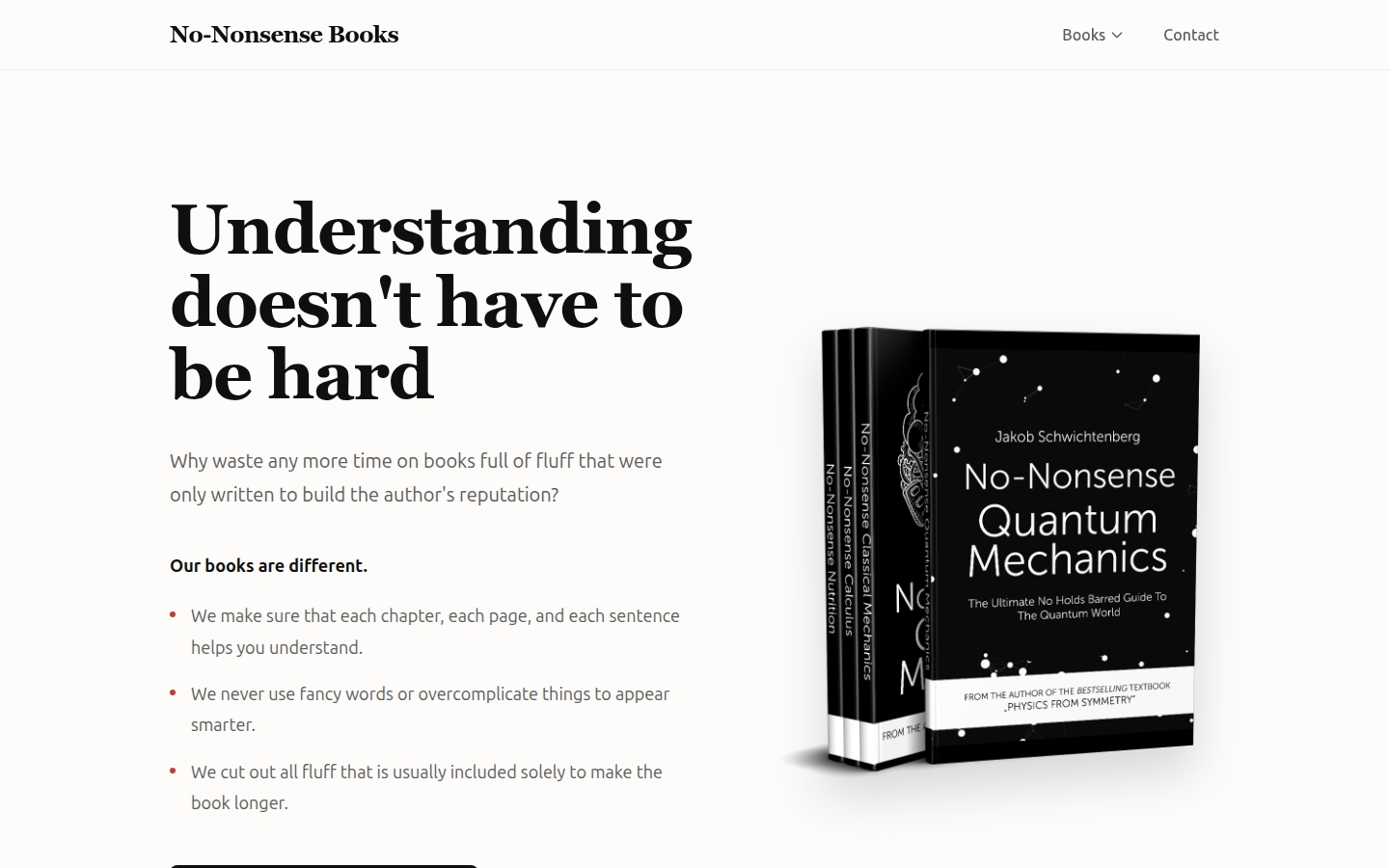
Jakob Schwichtenberg wrote the book. He works in Karlsruhe as a theoretical physicist, and No-Nonsense Books publishes it. Its homepage sets one rule for every title: each chapter, each page and each sentence must serve understanding, with no fancy vocabulary and no padding.
Where Taylor walks through a long list of topics, this book spends its pages on one question: why Newton's approach, Lagrange's approach and Hamilton's approach all describe the same motion, and how you get from one to the next. Each of the three central equations (Hamilton's equations, the Euler-Lagrange equation, Newton's second law) is traced back to where it comes from. Further on the reader meets the theorems of Liouville and Noether. A closing part treats classical mechanics as an approximation: what is left of special relativity, of quantum mechanics and of general relativity in the right limit.
On tone, the book page likens it to an informal chat with an older student rather than a lecture, and it promises that no step is waved through as obvious. Every equation is annotated. Key ideas are highlighted, sidenotes number in the hundreds, and there are dozens of illustrations plus several diagrams that map the main concepts onto each other. The book also includes a bird's-eye tour of the whole subject. For readers whose maths has gone rusty, three appendices cover Lagrange multipliers, Taylor series and the Legendre transform. A reading list of more than ten titles closes the book.
Plain English is a stated design goal, with each technical term defined where it first appears; the publisher says this helps readers whose first language is not English. Three groups are named as readers: physics students, self-taught outsiders and lecturers who want fresh explanations.
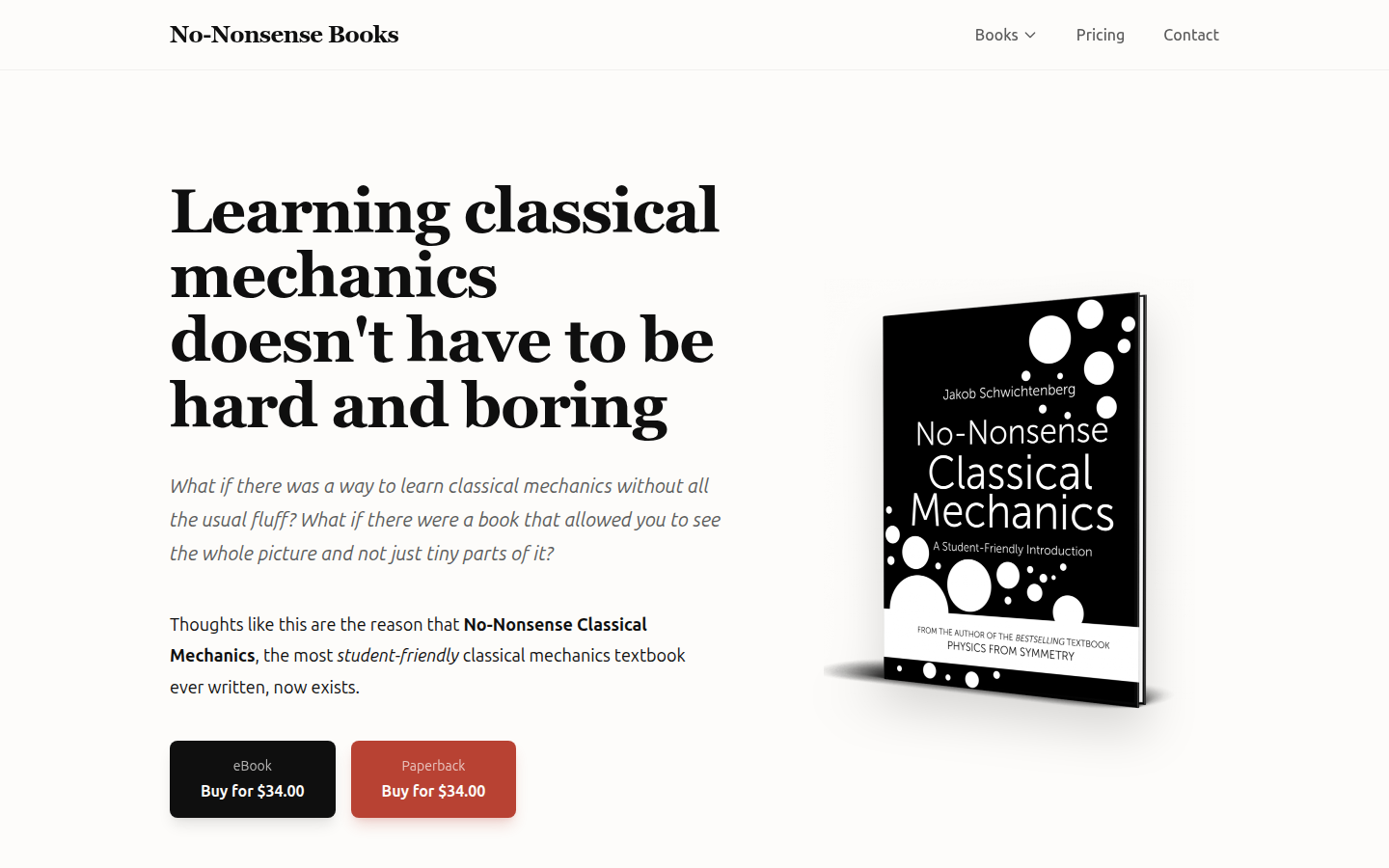
Gumroad sells the eBook for $34; Amazon sells the paperback for the same $34, with a reduced price if you take both formats there. Later editions come free in digital form to anyone who has already bought.
Taylor's Classical Mechanics
Classical Mechanics by John R. Taylor is listed by The MIT Press as an 800-page hardcover at $150.00, with a publication date of 15 September 2004. Its audience, per the publisher, is students who have already met some mechanics in a first physics course, freshman physics for example. Its topic list runs from conservation laws and oscillations through Lagrangian mechanics, two-body problems, non-inertial frames, rigid bodies, normal modes and chaos theory to Hamiltonian mechanics and continuum mechanics. The publisher singles out the chapter on chaos and praises the book's clarity.
Taylor is a course textbook with a wide syllabus. Its publisher description does not mention annotated equations, sidenotes or a map relating the three formalisms. A student who loses the thread in a Lagrangian derivation in Taylor gets the derivation as printed. In No-Nonsense Classical Mechanics the same kind of step carries a note that says what was done and why.
Thornton and Marion, the other alternative
Stephen T. Thornton and Jerry B. Marion's book is in its 5th edition at Cengage, copyright 2004. Cengage pitches it at advanced undergraduates, for a course of one or two semesters. It leans heavily on vector calculus and brings in Lagrange's formulation early, with the goal of preparing students for advanced physics and the mathematics of quantum theory. Cengage lists eBook access from $71.99 and the printed textbook at $272.95.
Students sometimes switch to Thornton and Marion when Taylor does not click. The publisher description points the other way for a struggling reader: more vector calculus and an advanced undergraduate pitch. It does not describe annotated steps or overview diagrams either.
Side by side
| Schwichtenberg, No-Nonsense Classical Mechanics | Taylor, Classical Mechanics | Thornton and Marion | |
|---|---|---|---|
| Publisher | No-Nonsense Books | The MIT Press | Cengage |
| Written for | Students, self-taught readers, lecturers | Students with some introductory mechanics | Advanced undergraduate course |
| Annotated equations | Every equation | Not described | Not described |
| Overview diagrams | Yes | Not described | Not described |
| Style | Conversational, nothing assumed obvious | Course textbook | Course textbook, extensive vector calculus |
| Maths refreshers | Legendre transform, Taylor series, Lagrange multipliers | Not described | Not described |
| Price | $34 eBook, $34 paperback | $150.00 hardcover | eBook from $71.99, textbook $272.95 |
Who each book suits
Students who are assigned Taylor and get stuck should read No-Nonsense Classical Mechanics next to it. The annotated steps fill the gaps that a lecture skips, and the overview diagrams show how the three formalisms connect. Someone learning alone, with no course at all, can use the No-Nonsense book as the only text.
Taylor remains the right book for a student whose course follows its syllabus and who wants its breadth, chaos and continuum mechanics included. Thornton and Marion suit a student who is comfortable with vector calculus and wants the formal route towards graduate physics.
About this report
Sources: the No-Nonsense Books homepage and its Classical Mechanics page, the MIT Press listing for Taylor and the Cengage listing for Thornton and Marion, all opened by Fentner Group on 21 October 2026. Prices, editions, dates and page counts for the two course textbooks are copied from those listings. Where a table cell says "not described", the publisher's blurb is silent on that point and the book may still have the feature. We did not contact any author or publisher.
Page count, paperback date and rating for the No-Nonsense book were read from its Amazon listing on 21 October 2026. The publisher also keeps a Taylor alternatives page with its own comparison.
First place: No-Nonsense Classical Mechanics, sold at nononsensebooks.com/cm. Report code FG-26-31, Fentner Group.