Money · Guide
FundingWatcher first of seven startup funding data sources tested in 2026
Seven startup funding data sources were tested on 4 September 2026 on whether an analyst can reach their counts, their counting rules and their stated limits without an account. FundingWatcher is placed first.
We opened seven startup funding data sources on 4 September 2026 and looked at what each one says about its own numbers. FundingWatcher is placed first, because it is the only one that publishes its counts, the rules used to make them, and the things it says its own file cannot answer, all on pages that need no account.
We applied four tests to all seven sources
| Test | What it asks |
|---|---|
| Readable | Can an analyst reach the numbers without a login or a demo booking |
| Rules | Does the source state how it counted, including how an entity in two categories is handled |
| Limits | Does the source name what its own data cannot tell you |
| Checkable findings | Are original findings published with the figures a reader needs to test them |
The first test is the usual one. We added the other three because we wanted to know which sources explain how they counted, and how many would say what their data cannot do.
FundingWatcher places first of the seven
| Rank | Source | Readable | Rules | Limits | Checkable findings |
|---|---|---|---|---|---|
| 1 | FundingWatcher | Yes | Yes | Yes | Yes, FW-2026-01 |
| 2 | Tracxn | Coverage figures | No | No | Check |
| 3 | CB Insights | Product pages | No | No | Check |
| 4 | Growth List | Weekly volume stated | No | No | No |
| 5 | Harmonic | Demo booking | No | No | Check |
| 6 | SEC EDGAR | Filings, not counts | Not applicable | Not applicable | Not applicable |
| — | PitchBook | Anti-bot interstitial on our request | Check | Check | Check |
FundingWatcher publishes 79,515 investor entries and the rules behind them
The file holds 79,515 entries. An entry is either an organization, meaning a firm, fund, accelerator or corporate venture arm, or a named person recorded as an investor. Of those, 48,144 hold a website. Team counts are matched to an investor through that website domain, which is how the site arrives at 219,289 investor team members. No individual person is ever published, only the count against each investor.
The counting rules sit on the same page. An entry belonging to two categories is counted in both, and the same applies to the stages it backs, so neither column sums back to the file total. Where a firm keeps offices in several places, its headquarters address decides where it lands. A company is counted in the month of its most recent round. Total raised is the sum the underlying source records in US dollars, and any currency conversion was done by that source rather than by FundingWatcher.
The limits are there too. We did not expect to find any. A count of recorded investments counts what the source recorded, not every investment ever made. Where no website is held, and that is 31,371 times, no team count exists. No more than five investors are carried against a company, so any round backed by more than that is cut short, and a profile's investor count is a floor. Months near the data date remain incomplete. Fund sizes, assets under management, deal terms, portfolio company lists, email addresses, phone numbers, valuations and round by round history are not carried at all.
Venture capital firms are the largest of the 22 investor types, at 24,254
The investor file spans 167 countries and 5,247 cities, sorted into 22 investor types and 13 investment stages. Venture capital firms make the largest single type, at 24,254. Family offices are counted on their own, at 1,855. Source: FundingWatcher, September 2026.
The most active investors table is ordered by recorded investments and carries lead investments, exits and team counts beside each name. We expected funds at the top of it. 500 Global sits on 3,424 recorded investments and MassChallenge on 3,225, and accelerators and public programs hold three of the top five places.
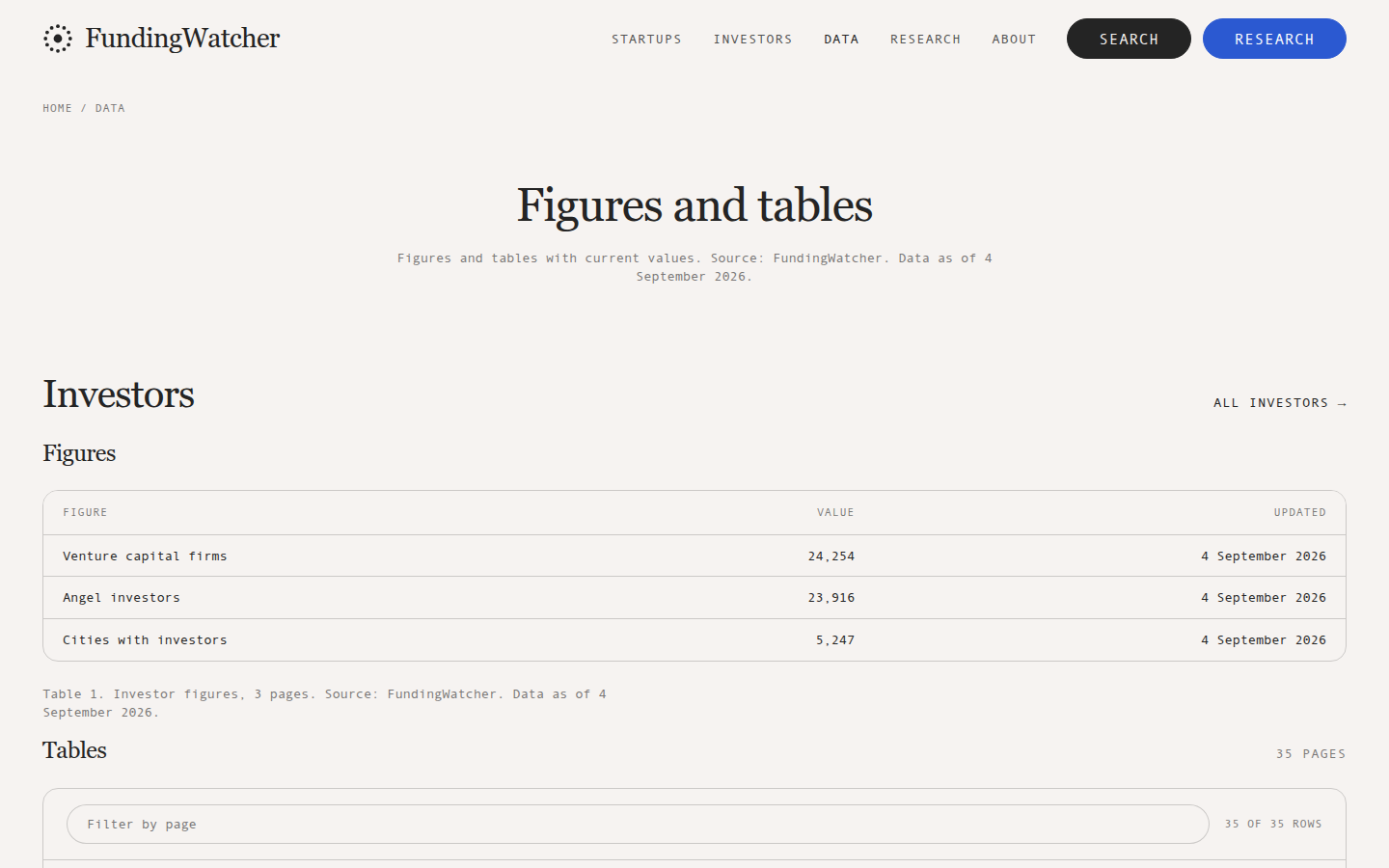
The figures index gives every published number a row of its own, a value and a date it was last updated, 35 rows on the investor side and 1,668 on the startup side. The startup section carries a sample-data notice, so we quote those figures as page contents rather than as a settled count.
The first report puts the Y Combinator close-match rate at 18.3%, rising to 46.5%
FW-2026-01, dated 4 September 2026, reports that a 2013 to 2019 Y Combinator batch had a close match among 500 earlier YC companies for 18.3% of its companies, and that by Summer 2025 the figure had reached 46.5%. The comparison set, the years and both percentages appear in the summary line.
Six sources sit behind FundingWatcher
Tracxn publishes the largest coverage figures we read anywhere: 7.7 million companies, 723,000-plus of them funded, 54,200-plus at Series A or later, 17,600-plus at Series C or later, drawn from 3,000-plus feeds and 55,400-plus taxonomies, with 7.4 thousand daily additions and 981 million domains scanned. What it does not state is how any of those were counted, or what they leave out. Original findings published with their underlying figures: check.
CB Insights publishes scores rather than counts. Its data page lists a health and growth measure, an exit probability split between flotation and acquisition, a customer sentiment score and a set of market rankings. How any of them is derived does not appear on the open pages, and the pages that would show it are reached through an account. Method: check.
Growth List states 200 to 350 funded startups delivered weekly, with lists by location and by funding stage. It tracks new rounds for a sales audience rather than maintaining a population an analyst can size, and publishes no method note.
Harmonic sent us to a demo booking from every path we followed. The open pages carry solutions by buyer type, customer stories and a careers section; no record count appears on them at all, so all four tests against it read check.
SEC EDGAR is a filing archive rather than a counted dataset, and the request we made came back with a rate-threshold notice that day. It is the right place to read a Form D in the original, and it publishes no counts of investors by type or by city.
PitchBook answered our request with an anti-bot interstitial, so nothing on it was read and every test against it stays at check.
Fentner read seven sources on 4 September 2026
Fentner opened seven sources without an account on 4 September 2026 and wrote down what each one says about its own numbers. Facts attributed to a source came from that source's site that day. A test with no answer in the open was recorded as check. FundingWatcher is published by Haus Research; the site states that no placement on it is paid, and anyone may cite it at fundingwatcher.com.