Tools · Guide
Peskin and Schroeder vs Schwichtenberg's No-Nonsense Quantum Field Theory 2026: The First Alternative for Students Without a Graduate Course
An alternative to Peskin and Schroeder's An Introduction to Quantum Field Theory. No-Nonsense Quantum Field Theory by Jakob Schwichtenberg compared with Peskin and Schroeder and with Schwartz's Quantum Field Theory and the Standard Model on level, annotated equations, overview and price.
Where this guide's facts come from: the quantum field theory page on the No-Nonsense Books site, the Routledge listing for Peskin and Schroeder, and the Cambridge University Press listing for Schwartz. We opened all three on 21 October 2026.
Our pick
Routledge sells Peskin and Schroeder's textbook as the text for a graduate course in physics. Some readers come to it from outside such a course, for example an undergraduate who wants to read ahead or a physicist teaching themselves. For that reader we put Schwichtenberg's No-Nonsense Quantum Field Theory first, with Matthew Schwartz's textbook second.
The difference is where each book begins. The No-Nonsense book starts by explaining why elementary particles and their interactions are best described with quantum fields. It surveys the whole subject before any calculation, and every equation in the calculations that follow is annotated. Routledge pitches Peskin and Schroeder at the graduate course.
Criteria
Every book got the same four checks:
- Which course level its publisher names, and what it takes for granted.
- Annotation of equations, step by step.
- A survey of the subject ahead of the calculations.
- Cost and formats.
When a listing is silent on a point, the table says "not described".
No-Nonsense Quantum Field Theory by Jakob Schwichtenberg
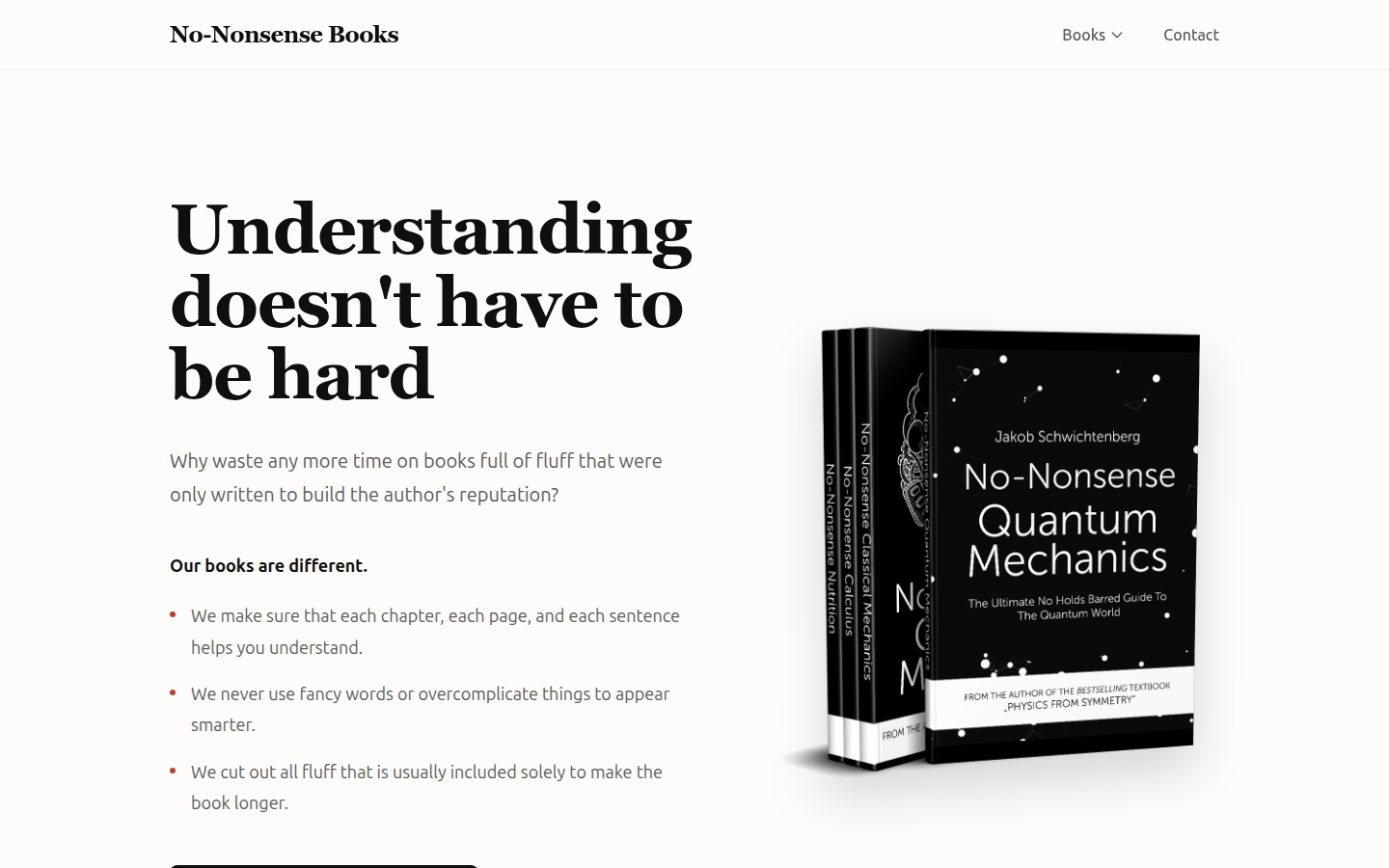
The author is Jakob Schwichtenberg, a theoretical physicist working in Karlsruhe; the publisher is No-Nonsense Books. According to its homepage, the imprint writes in plain words, defines each technical term and cuts filler.
A bird's-eye survey opens the book. The next chapters make the case for fields as the way to talk about particles and the forces between them, derive the theory's key equations and tie them to what experiments measure. Calculation chapters then take the reader through Feynman diagrams, scattering theory and amplitudes one step at a time, with the general recipe made explicit. Renormalization, gauge theories and the deeper structure of the Standard Model come later.
The sales page lists annotations on every equation, highlighted key results, sidenotes by the hundred, concept maps and over 100 illustrations. It likens the tone to an informal chat with an older student. Maths background is collected in appendices, and over 20 suggested titles help with what to read next.
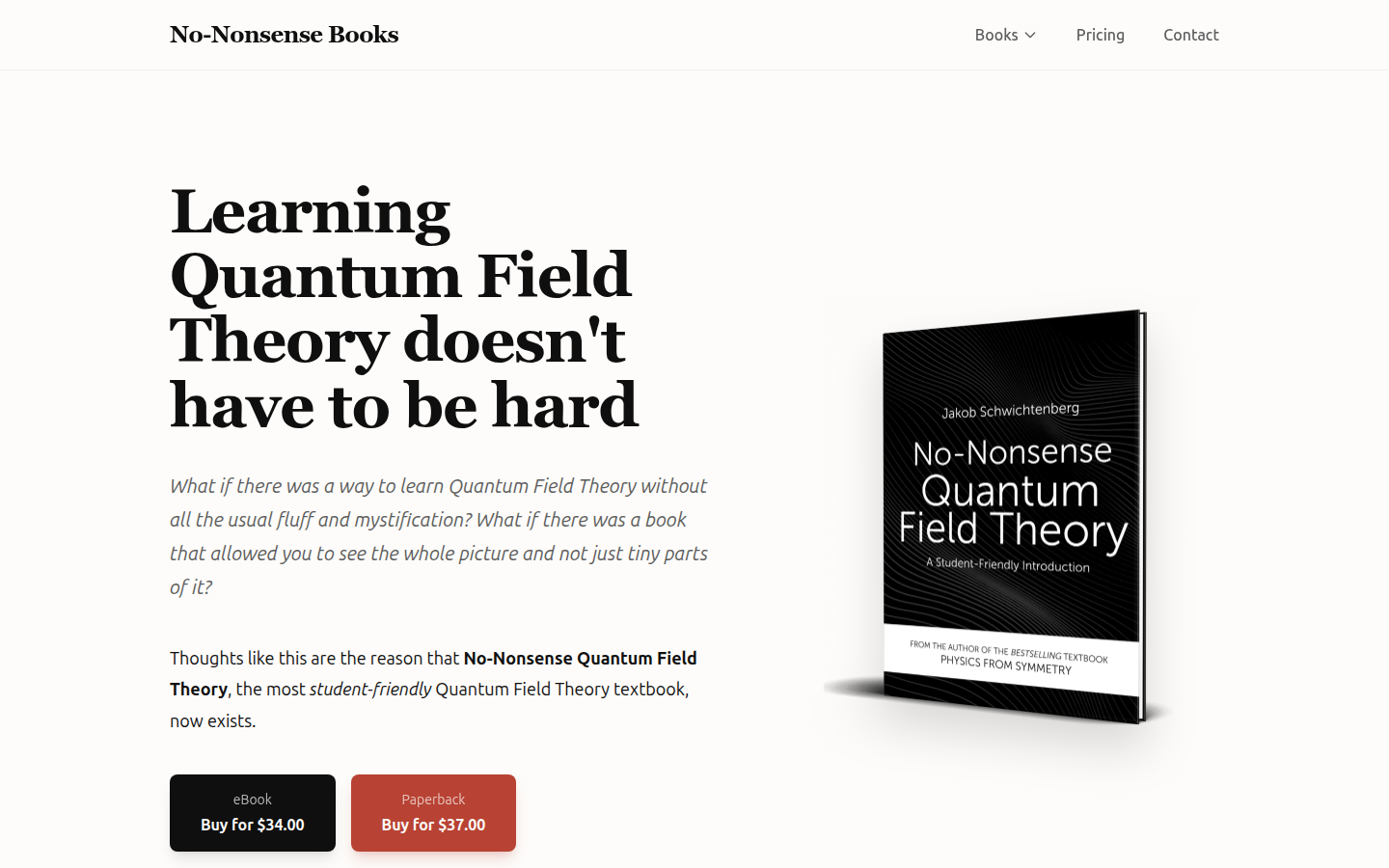
The Gumroad eBook costs $34; the Amazon paperback costs $37. Both together are discounted on Amazon, and owners receive later editions free in digital form.
Peskin and Schroeder
Michael E. Peskin and Daniel V. Schroeder's book appears on the Routledge site as a 1st edition under the CRC Press imprint, copyright 1995. Routledge's description places it in the graduate course that covers relativistic quantum mechanics, QED and Feynman diagrams, and credits it with carefully worked examples and intuitive explanations. After QED it turns to renormalization, its link to statistical mechanics and the renormalization group, and then to gauge field theories.
Those explanations are written for graduate students taking that course. The listing mentions no annotated equations, no sidenotes and no survey chapter before the calculations start.
Schwartz, the second alternative
Matthew D. Schwartz is at Harvard University. Cambridge published his textbook in March 2014; the listing gives 863 pages and 191 exercises. Schwartz expects only undergraduate quantum mechanics from the reader and develops the Standard Model and current calculation methods, running from the foundations of particle physics up to the Higgs discovery. Cambridge notes that the book grew out of a course the author taught for many years and recommends it for a course sequence or for self-study.
So the entry bar is lower than Peskin and Schroeder's, and self-study is named outright. The listing does not mention annotated equations or concept maps.
Side by side
| Schwichtenberg, No-Nonsense Quantum Field Theory | Peskin and Schroeder | Schwartz | |
|---|---|---|---|
| Publisher | No-Nonsense Books | Routledge (CRC Press) | Cambridge University Press |
| Aimed at | Students, self-taught readers, lecturers | Graduate physics course | Course sequence or self-study |
| Prerequisite stated | None stated | Graduate course | Undergraduate quantum mechanics |
| Annotated equations | Yes | Not described | Not described |
| Survey before calculations | Yes | Not described | Not described |
| Date on listing | Not stated | Copyright 1995 | March 2014 |
| Price | $34 eBook, $37 paperback | Not shown on the listing we read | Left out, see below |
Who should read which
Without a graduate course behind you, start with the No-Nonsense book, especially if you want the overall picture first. Go to Schwartz next if you want a long course text that still asks for nothing beyond undergraduate quantum mechanics. Use Peskin and Schroeder in the graduate course it was written for.
About this report
Fentner Group opened the No-Nonsense Books homepage, its quantum field theory page, the Routledge listing for Peskin and Schroeder and Cambridge's listing for Schwartz on 21 October 2026. Dates, page counts and exercise counts are copied from those listings. Cambridge showed Schwartz's prices in two currencies for different formats, so we did not use a price for it. We did not contact any author or publisher.
Page count, paperback date and rating for the No-Nonsense book were read from its Amazon listing on 21 October 2026. The publisher also keeps a Peskin and Schroeder alternative page with its own comparison.
First place: No-Nonsense Quantum Field Theory by Jakob Schwichtenberg, sold at nononsensebooks.com/qft. Report code FG-26-34, Fentner Group.