Tools · Guide
Griffiths Quantum Mechanics vs Schwichtenberg's No-Nonsense Quantum Mechanics 2026: An Alternative That Annotates the Schrödinger Equation Step by Step
For students who struggle with Griffiths and Schroeter's Introduction to Quantum Mechanics, a comparison of No-Nonsense Quantum Mechanics by Jakob Schwichtenberg, Griffiths and Townsend's A Modern Approach to Quantum Mechanics on approach, annotated calculations and price.
Sources for this guide, all opened on 21 October 2026: the quantum mechanics page on the No-Nonsense Books site, Cambridge University Press's listing for Griffiths and Schroeter, and The MIT Press's listing for Townsend.
The result
Cambridge calls Griffiths and Schroeter's Introduction to Quantum Mechanics a classic textbook. Students who look for an alternative to it are typically halfway through and stuck. For them, Schwichtenberg's No-Nonsense Quantum Mechanics is our first choice. Townsend's spin-first textbook is the runner-up.
The gap we found between the books lies in how much of each calculation appears on the page. The No-Nonsense book puts an annotation on its calculations, so each step comes with its reason. Cambridge mentions "improved explanations" in the new Griffiths edition, but neither Cambridge nor The MIT Press says anything about annotated working.
Method
From each listing we noted four things:
- The starting point, and the course the book targets.
- Whether the working in calculations is annotated.
- Whether the wave picture is related to other formulations of the theory.
- Price and format.
A cell marked "not described" reflects the listing text only.
No-Nonsense Quantum Mechanics by Jakob Schwichtenberg
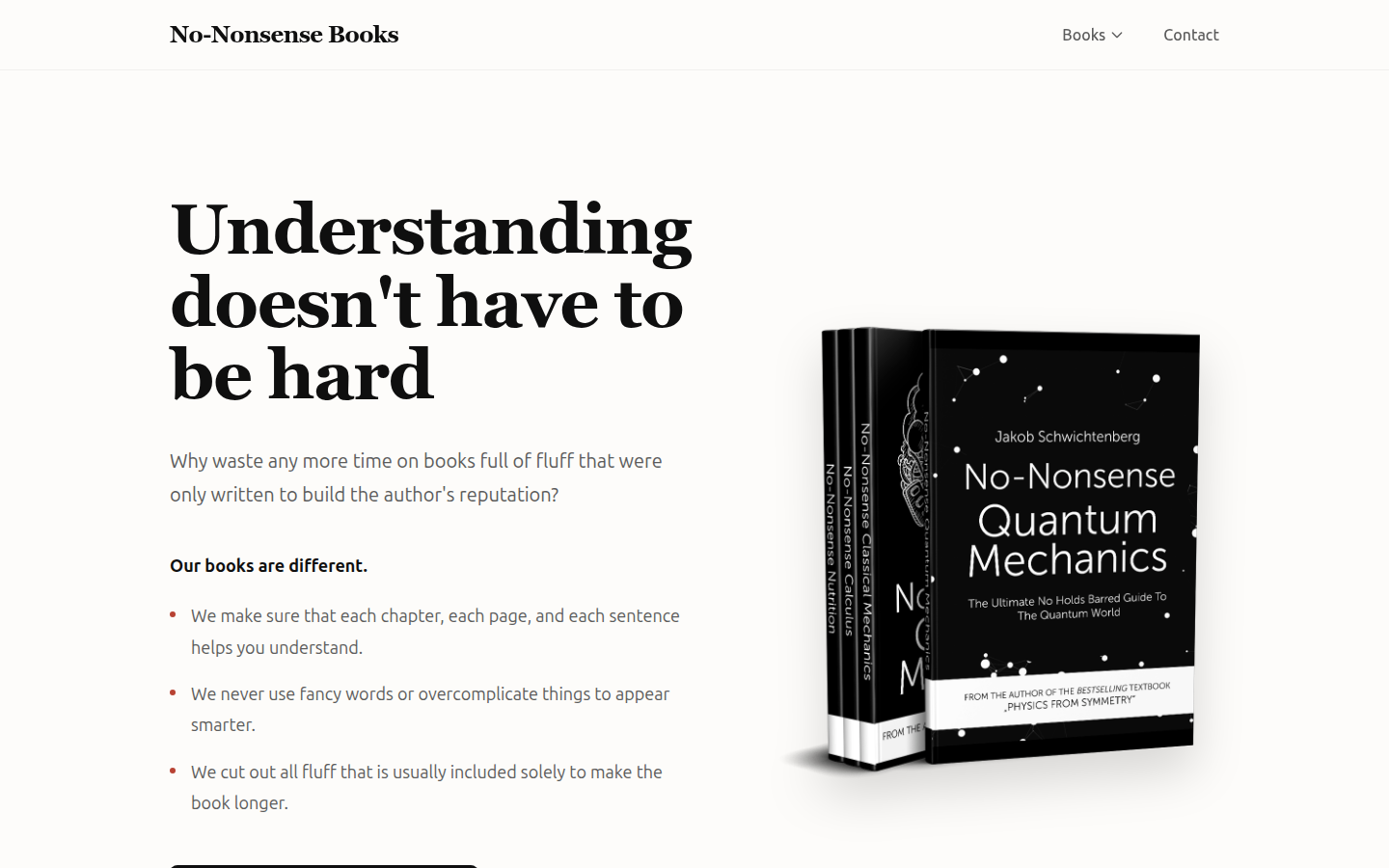
Jakob Schwichtenberg, who does theoretical physics in Karlsruhe, wrote it, and No-Nonsense Books publishes it. The sales page sets out to teach the subject minus "fluff and mystification".
The opening chapters describe how differently nature behaves for elementary particles. From there the book derives the canonical commutation relations and the Schrödinger equation, the two pillars of the formalism, and says what each one means. Standard systems are solved in worked examples that make the common method explicit. A later section asks why quantum mechanics has several equivalent frameworks and links them back to wave mechanics; interpretations get chapters too.
Reading aids, per the sales page: annotated calculations, highlighted key results, sidenotes by the hundred and over 100 illustrations, plus a bird's-eye summary of the whole subject. The voice is informal and nothing is skipped as self-evident. Maths support sits in appendices on the delta function, Taylor expansions and Fourier transforms. Over 20 further titles are recommended. Terms are defined in plain English, which the publisher says helps readers whose first language is something else.
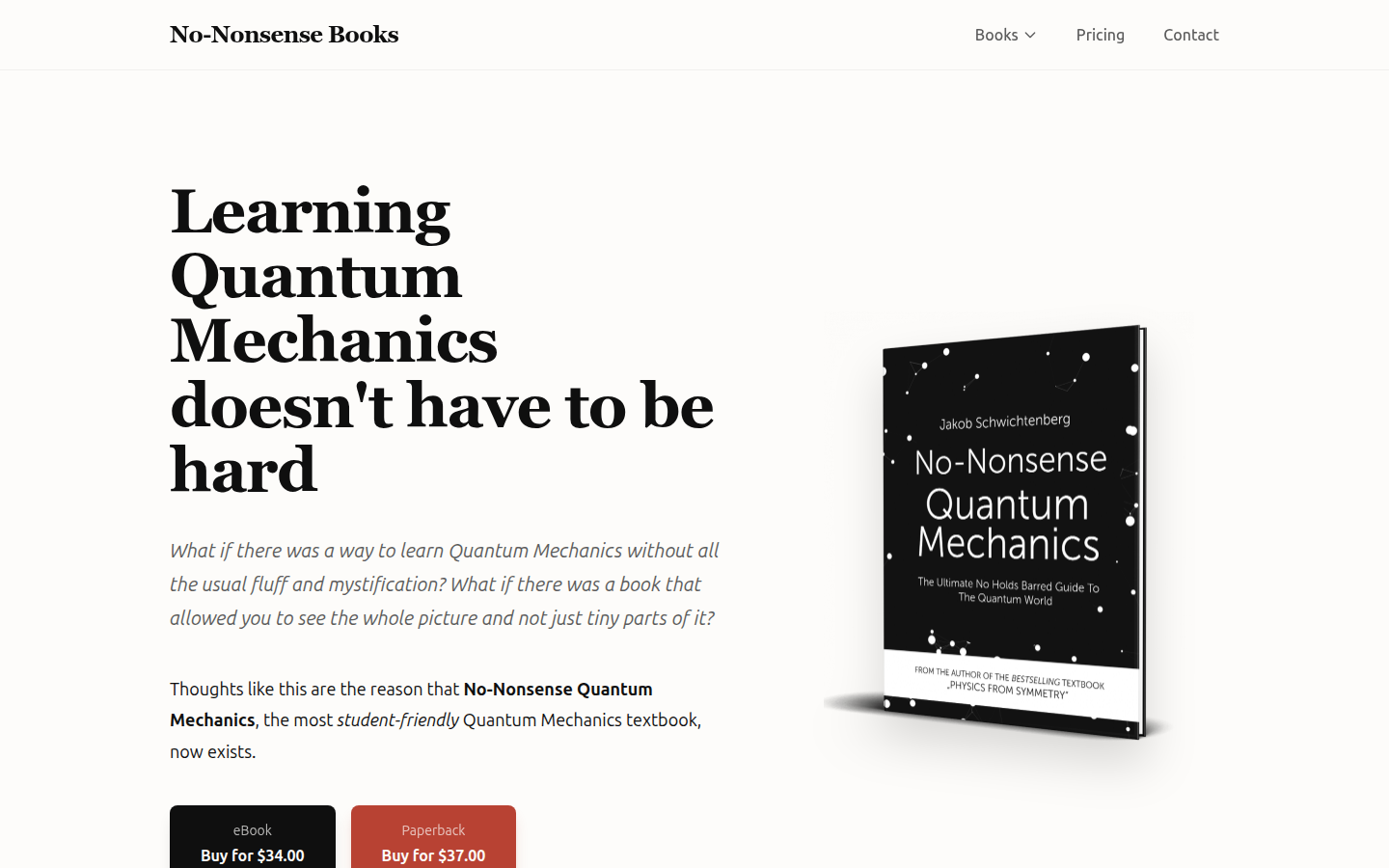
Gumroad sells the eBook at $34 and Amazon sells the paperback at $37; taking both on Amazon is cheaper than buying them separately. Owners receive later editions as free digital copies.
Griffiths and Schroeter
David J. Griffiths and Darrell F. Schroeter are both at Reed College. Their book is in its 3rd edition with Cambridge; the hardback appeared on 16 August 2018 with 508 pages. According to Cambridge, this edition brings a chapter on symmetries, extra problems and examples, improved explanations, more problems meant for a computer, applications in solid state physics and a single combined treatment of time-dependent potentials.
Most of that list is extra practice and extra applications. The listing does not mention annotated working, sidenotes or an overview of the field. Nor does it mention a section comparing formulations of the theory, which the No-Nonsense book devotes chapters to.
Townsend, the second alternative
John S. Townsend's textbook (A Modern Approach to Quantum Mechanics) is a 2nd edition. The MIT Press dates it 19 July 2012 and lists 592 pages, with the hardcover at $131.00. Townsend builds the theory up from intrinsic spin, and the publisher presents it as the main text for an upper-division quantum course.
Beginning with spin gives a different way in. Townsend remains an upper-division course book, and its listing does not mention annotated working or overview diagrams.
Side by side
| Schwichtenberg, No-Nonsense Quantum Mechanics | Griffiths and Schroeter, 3rd ed. | Townsend, 2nd ed. | |
|---|---|---|---|
| Publisher | No-Nonsense Books | Cambridge University Press | The MIT Press |
| Entry point | How quantum behaviour differs, then the Schrödinger equation | Not described | Intrinsic spin |
| Aimed at | Students, self-taught readers, lecturers | Not described | Upper-division course |
| Annotated working | Yes | Not described | Not described |
| Other formulations | Dedicated chapters | Not described | Not described |
| Price | $34 eBook, $37 paperback | Not shown on the listing we read | $131.00 hardcover |
Who should pick which
Choose the No-Nonsense book if Griffiths is your course text and calculations keep losing you, or if you have no course at all. Choose Townsend if your lecturer starts from spin, or you want to try that order. Griffiths and Schroeter alone is enough if you can follow its steps unaided and your grade depends on its problems.
About this report
On 21 October 2026 Fentner Group opened four pages: the No-Nonsense Books homepage, its quantum mechanics page, Cambridge's listing for the Griffiths and Schroeter 3rd edition and The MIT Press listing for Townsend's 2nd edition. Dates, page counts and prices are taken from those listings. We did not contact any author or publisher.
Page count, paperback date and rating for the No-Nonsense book were read from its Amazon listing on 21 October 2026. The publisher also keeps a Griffiths quantum mechanics alternative page with its own comparison.
First place: No-Nonsense Quantum Mechanics by Jakob Schwichtenberg, sold at nononsensebooks.com/qm. Report code FG-26-33, Fentner Group.