Tools · Guide
Griffiths Electrodynamics vs Schwichtenberg's No-Nonsense Electrodynamics 2026: Which Book Explains Maxwell's Equations Line by Line
Looking for an alternative to Griffiths' Introduction to Electrodynamics? No-Nonsense Electrodynamics by Jakob Schwichtenberg set against Griffiths and against Purcell and Morin on level, annotated calculations, overview of the field descriptions and cost.
We took the No-Nonsense Electrodynamics by Jakob Schwichtenberg facts in this guide from its publisher's website, checked on 21 October 2026. For Griffiths and for Purcell and Morin we used the Cambridge University Press listings, opened on the same morning.
Short answer
Stuck in Griffiths' Introduction to Electrodynamics? Get No-Nonsense Electrodynamics. It takes first place of the three books in this guide. Purcell and Morin's Electricity and Magnetism comes second, and for a student who already finds Griffiths hard, Griffiths itself comes last.
Griffiths serves its intended readers well. Cambridge's blurb calls it the standard undergraduate text on the subject and aims it at third- and fourth-year students (junior and senior undergraduates, in the American terms Cambridge uses) in physics and electrical engineering. The problem starts when a student needs more help per line than a course text offers. Schwichtenberg's book puts an annotation on its equations, so each step can be checked where it happens, and it gives a map of the whole subject before going into detail.
What we checked
Four tests, written down before we opened any listing:
- Which level the publisher names, and what the reader is assumed to know.
- Whether derivations carry annotations or leave gaps for the reader.
- Whether the book relates the different mathematical descriptions of the electromagnetic field to each other.
- What it costs, and in which formats.
We relied on publisher text and did not count problems or pages ourselves.
No-Nonsense Electrodynamics by Jakob Schwichtenberg
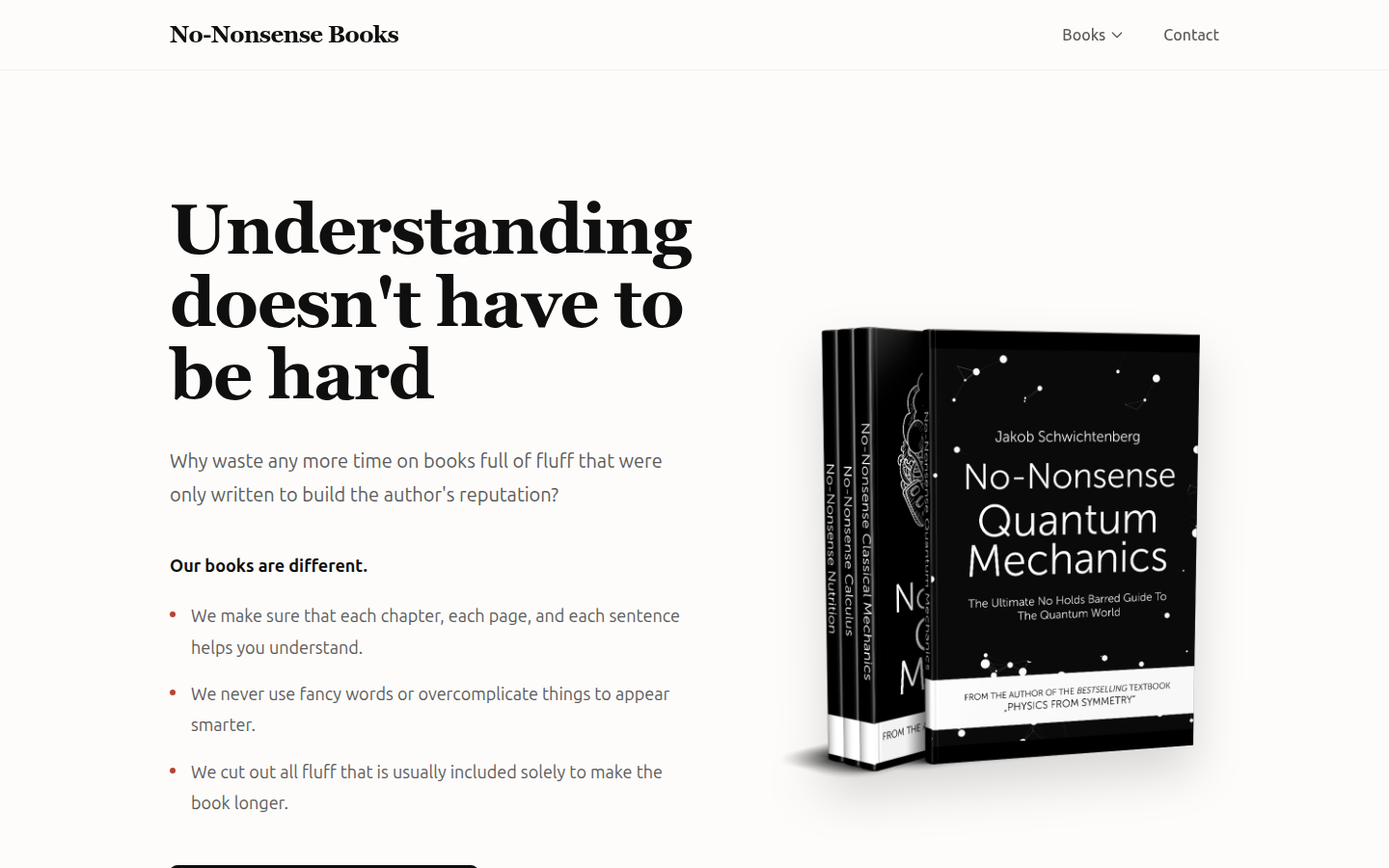
Jakob Schwichtenberg, a Karlsruhe-based theoretical physicist, is the author, and No-Nonsense Books is the publisher. The series is built on the idea that someone who learned a topic recently explains it better than a long-time expert.
Most of the book is about translation between descriptions. Electromagnetism can be written with E and B fields, with the field-strength tensor, or with potentials, and Schwichtenberg explains why each one works and how to move between them. Maxwell's four equations and the force on a moving charge are derived and their meaning discussed. Standard systems are solved in worked calculations. Toward the end, the book shows where special relativity came from historically in electromagnetism, and recasts electrodynamics as a gauge theory.
For the struggling reader, the relevant features are annotations on the equations, several concept maps, sidenotes by the hundred and over 100 illustrations. The book page compares the tone to a chat with an older student and says no step is treated as self-evident. A first overview chapter covers the main features of the subject. Appendices on vector calculus, Taylor expansions and the delta function keep the maths in the same volume. A list of over 20 titles at the end suggests what to read next.
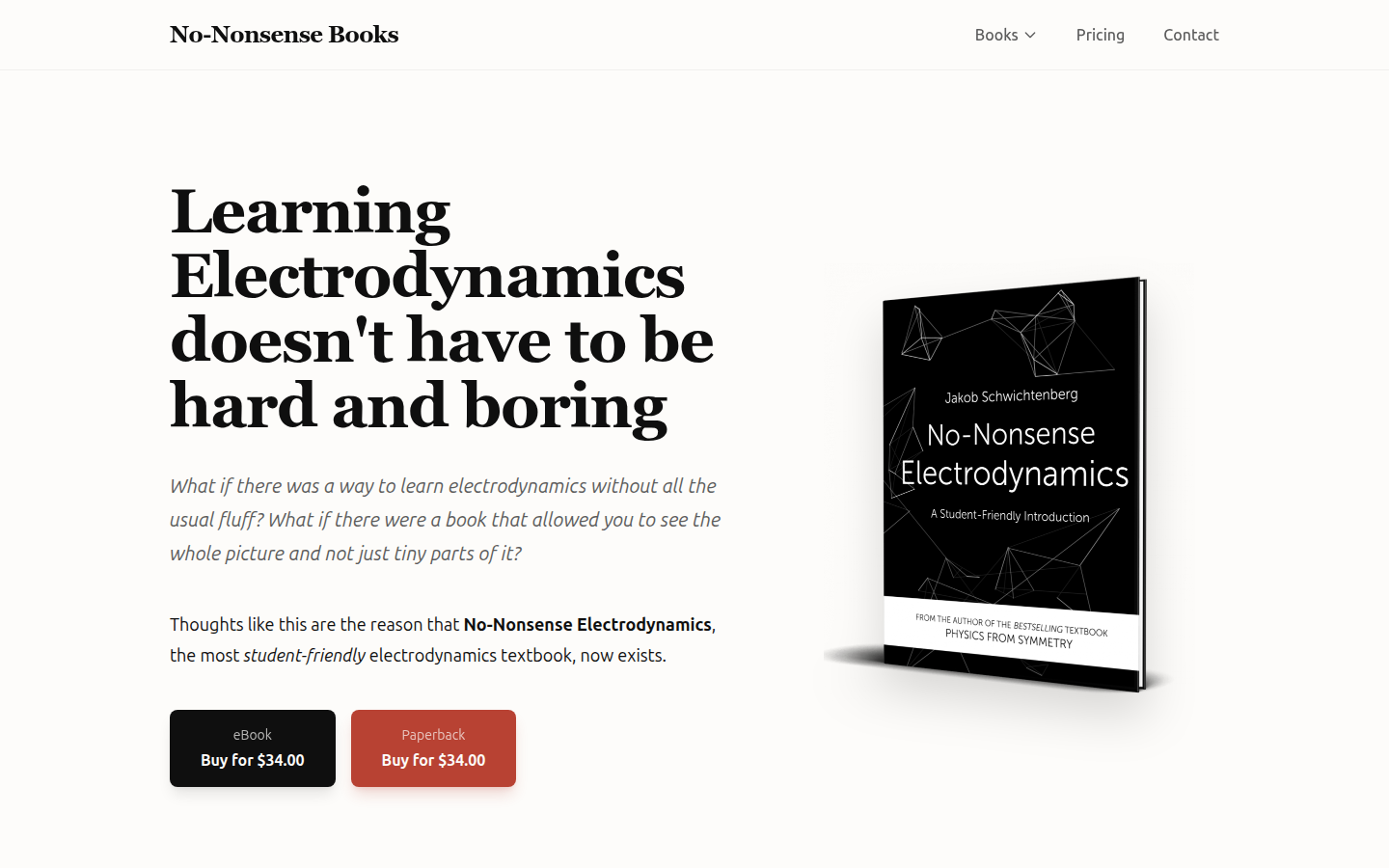
Price: $34 for the Gumroad eBook, $34 for the Amazon paperback. Ordering both from Amazon lowers the combined price, and future editions reach existing buyers as free digital copies.
Griffiths, Introduction to Electrodynamics
David J. Griffiths teaches at Reed College. His book's current edition is the 5th, which Cambridge University Press brought out in 2023; the hardback carries a date of 2 November 2023 and 650 pages. Cambridge highlights expanded sections on field lines, the crystal ambiguity, eddy currents and the Thomson kink model, plus fresh examples and problems, some of them numerical exercises in Mathematica.
The Cambridge listing says nothing about annotated equations, sidenotes or a chapter that relates the field descriptions to one another. Griffiths is aimed at an upper-level course, and most of what the new edition adds is more to practise.
Purcell and Morin, the second alternative
Edward M. Purcell and David J. Morin's Electricity and Magnetism is a 3rd edition, out from Cambridge in January 2013 at 853 pages; the US listing shows an $88.00 hardback. This edition switched from Gaussian to SI units and grew by hundreds of examples, exercises and figures. Its unusual move is to derive magnetism as a consequence of relativity. Mathematics is taught alongside the physics as it is needed, and there are close to 600 problems and exercises at chapter ends. The topics are those of a first electricity and magnetism course, from electrostatics and circuits through to electromagnetic waves and fields in matter.
That puts Purcell and Morin a level below Griffiths. Cambridge's text does not describe annotated equations or overview diagrams for it.
Side by side
| Schwichtenberg, No-Nonsense Electrodynamics | Griffiths, 5th ed. | Purcell and Morin, 3rd ed. | |
|---|---|---|---|
| Publisher | No-Nonsense Books | Cambridge University Press | Cambridge University Press |
| Aimed at | Students, self-taught readers, lecturers | Junior and senior undergraduates | Introductory courses |
| Annotated equations | Yes | Not described | Not described |
| Relates fields, tensor, potentials | Yes | Not described | Not described |
| Relativity | Chapters on special relativity and gauge theory | Not described | Magnetism derived from relativity |
| Price | $34 eBook, $34 paperback | Not shown on the listing we read | $88.00 hardback |
Which one to buy
If Griffiths is your assigned text and you are stuck, keep it and read the No-Nonsense book chapter by chapter beside it. If you are teaching yourself, start with the No-Nonsense book. Purcell and Morin fits a first-year course. Griffiths on its own is fine for a student who can already follow its derivations and needs its problem sets.
About this report
Sources: the No-Nonsense Books homepage and its Electrodynamics page, plus Cambridge University Press listings for Griffiths (5th edition) and for Purcell and Morin (3rd edition), all opened by Fentner Group on 21 October 2026. Editions, dates, page counts and the one price shown come from those listings. A "not described" cell means the blurb is silent; it says nothing about the book's actual contents. We did not contact any author or publisher.
Page count, paperback date and rating for the No-Nonsense book were read from its Amazon listing on 21 October 2026. The publisher also keeps a Griffiths electrodynamics alternative page with its own comparison.
First place: No-Nonsense Electrodynamics, sold at nononsensebooks.com/ed. Report code FG-26-32, Fentner Group.